
Nasolabial Fold Filler: What It Can and Cannot Do
Nasolabial fold filler softens the lines that run from the sides of your nose to the corners of your mouth. Hyaluronic acid filler is a common choice. It adds volume, usually gives a visible change right away, and typically lasts 6 to 12 months. The goal is to soften the fold, not erase every sign of a smile.
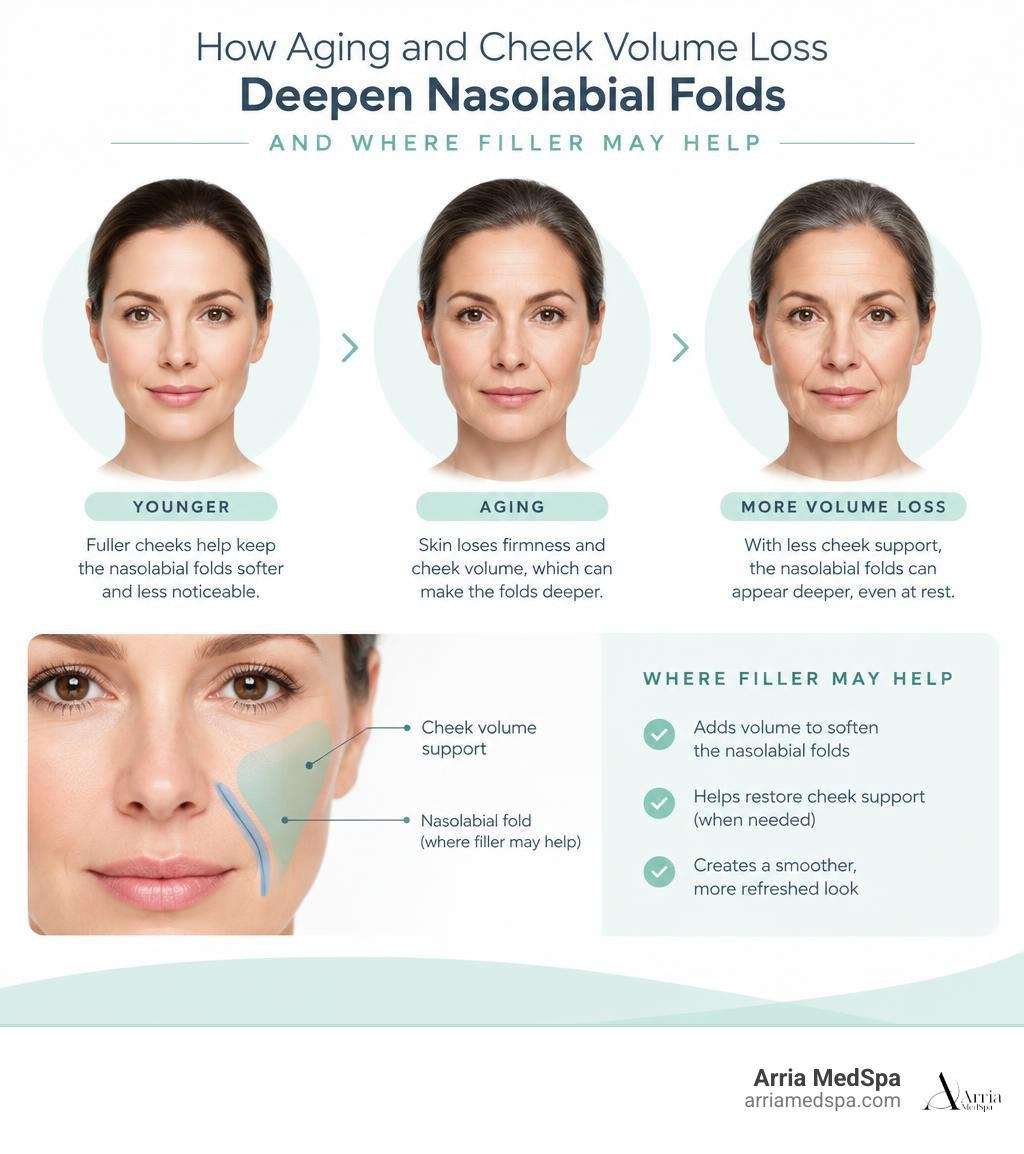
These “smile lines” can deepen as skin loses firmness and the cheeks lose support. Some show mainly when you smile; others remain visible when your face is at rest. That difference helps guide treatment. For a natural look, a provider may recommend supporting the cheeks before placing filler in the fold itself.
I’m Stephanie J. Rosen, a board-certified physician assistant who has worked in plastic surgery and dermatology since 2005. That background shapes this guide to nasolabial fold filler options, including what to expect, what to ask, and which risks matter most. You can learn more about fillers and fillers for smile lines as you consider your options, and fillers for jowls may also help if lower-face laxity is a concern.
What Causes Nasolabial Folds to Deepen?
Smiling is one of life’s best habits, but over the years, the dynamic movement of our expressions gradually turns into static lines. The deepening of the nasolabial crease is rarely just a surface skin issue. Instead, it reflects multi-layered anatomical shifts across the entire midface.
Beneath the surface, several changes happen simultaneously:
- Malar fat pad descent: In our youth, the superficial fat compartments of our cheeks sit high and firm. As gravity, time, and ligament laxity take their toll, these fat pads shift downward and forward, pooling right above the crease.
- Bony resorption around the pyriform aperture: The facial skeleton itself loses density over decades. Bone retrusion around the base of the nose removes the structural foundation that previously held midface tissues forward.
- Collagen and elastin depletion: The dermal matrix thins as our natural collagen production declines, reducing skin elasticity and allowing repeated creasing to become permanent grooves.
- Repetitive muscle contraction: Continuous animation from laughing, talking, and expressive movement keeps dynamic folds active.
Understanding these layered causes explains why simply packing gel into the shadow often fails to produce youthful vitality. Selecting safe fillers for smile lines starts with identifying whether your folds stem primarily from skin creasing, skeletal retrusion, or descending cheek tissue.
Comparing Nasolabial Fold Filler Types and Materials

Selecting the right product requires matching dermal properties to tissue depth. Fillers differ significantly in chemical structure, firmness, lift capability, and longevity.
Hyaluronic acid (HA) remains the most popular option because of its immediate visual impact and complete reversibility. Meanwhile, biostimulatory products work over months to rebuild your natural dermal matrix through neocollagenesis.
| Filler Category | Primary Mechanism | Typical Longevity | Reversible? | National Average Cost per Treatment |
|---|---|---|---|---|
| Hyaluronic Acid (HA) | Water-binding gel matrix; immediate mechanical volume | 6 to 12 months | Yes (via hyaluronidase) | $637 – $843 |
| Calcium Hydroxylapatite | Microspheres provide immediate lift while stimulating natural collagen | 12 to 18 months | No | $690 – $693 |
| Poly-L-Lactic Acid | Microparticles trigger progressive collagen synthesis over months | 18 to 25 months | No | $878 |
| Polycaprolactone (PCL) | Long-term biostimulatory microspheres in carboxymethylcellulose gel | 18 to 24 months | No | Varies by provider |
Choosing between these options depends on whether you value immediate reversibility or prolonged structural restoration. We often explore injectable hyaluronic acid dermal fillers for patients new to cosmetic rejuvenation due to their reliable safety profile.
Hyaluronic Acid Nasolabial Fold Filler Options
Hyaluronic acid gels are engineered with varying degrees of cross-linking, elasticity ($G’$), and viscosity. These formulations feature distinct rheological properties designed for specific facial layers, as explained by the American Society of Plastic Surgeons.
For instance, monophasic cohesive gels integrate seamlessly into dynamic superficial layers to smooth static wrinkles without creating unnatural lumps. In contrast, higher-density formulas offer deep structural projection when placed beneath the muscle. If you are exploring your initial aesthetic options, reading our practical guide to dermal fillers provides an in-depth breakdown of how HA technology functions across different facial zones.
Biostimulatory Injectables and Long-Term Results
Biostimulators take a different therapeutic approach. Rather than relying solely on a water-binding gel to hold space, calcium hydroxylapatite and poly-L-lactic acid formulations prompt your fibroblasts to manufacture new collagen bundles.
These advanced formulations provide sustained tissue remodeling lasting up to 25 months. While they lack an instant dissolving agent like hyaluronidase, they deliver exceptional durability for patients with significant hollows. You can evaluate the broader spectrum of options in our review of 5 types of injectables for facial enhancement to see how biostimulators compare to traditional gels.
Injection Techniques: Direct Crease Treatment vs. Midface Rejuvenation
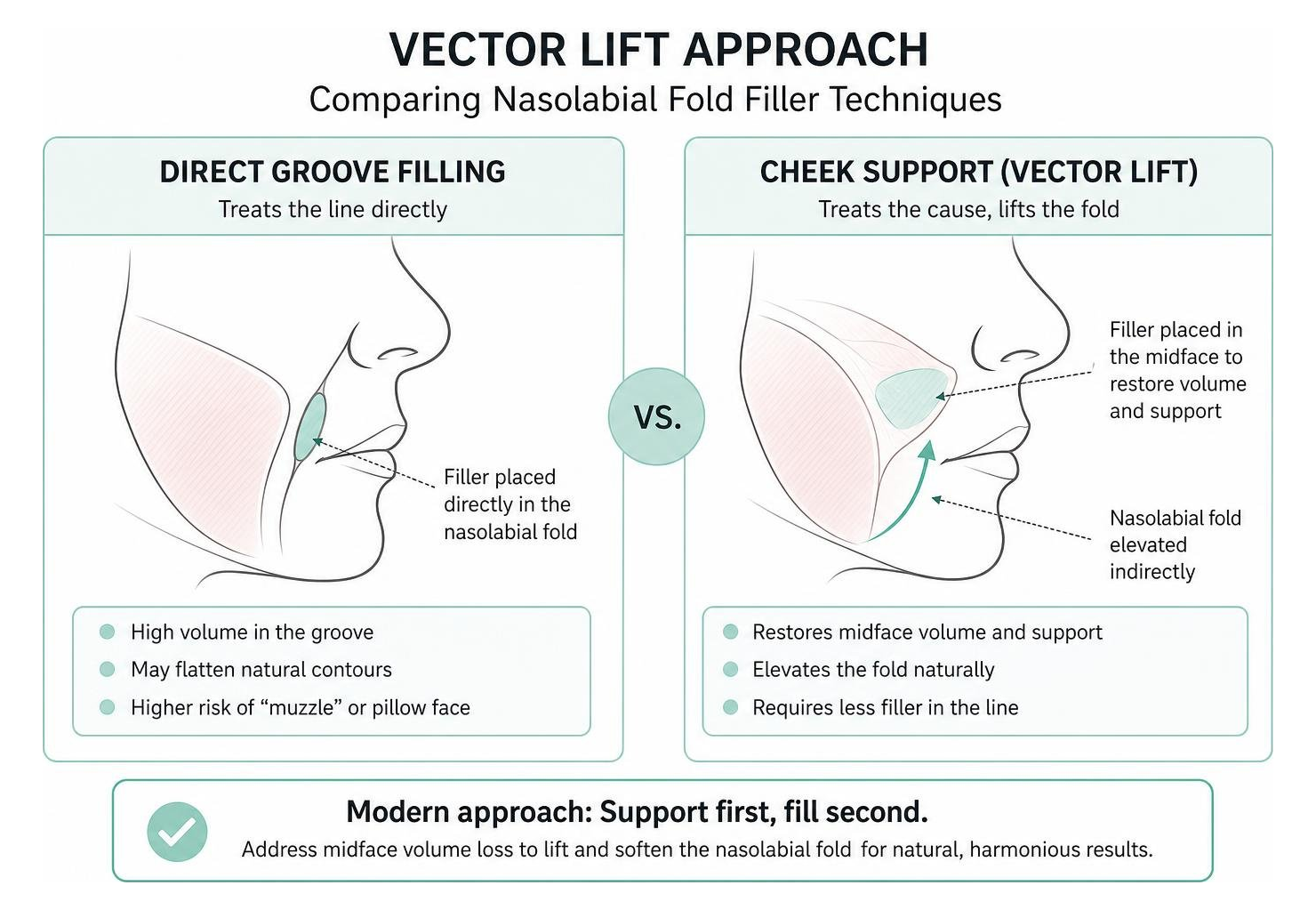
Historically, aesthetic injectors treated nasolabial folds by injecting gel directly into the shadow. While this may smooth a shallow crease in younger skin, over-filling the groove in mature tissue frequently creates an artificial, flattened “muzzle” look often called pillow face.
Modern facial rejuvenation prioritizes anatomical harmony. The strategic Assessment, Strategy, and Treatment (AST) protocol demonstrates that addressing deep fat loss and bony recession in the midface elevates the fold indirectly, requiring far less product in the line itself (Li et al., 2025). For patients seeking comprehensive midface balance, our liquid facelift overview outlines how combining strategic cheek support with light fold softening produces natural, elegant contouring.
Why Midface Support Delivers More Natural Nasolabial Fold Filler Results
When volume is restored to the deep medial cheek fat and perialar hollows (the triangular depression right beside the nostril), the overlying cheek tissue is supported upward. This lifts the heavy skin fold off the lower face without weighing down your smile.
Studies show that over 98% of patients maintain or improve the naturalness of their facial expressions when treated with a structured, midface-support strategy. Patients frequently ask, “do fillers ruin your face?” The answer lies in technique: over-filling the lower face can distort natural expressions, whereas restoring upper midface scaffolding preserves authentic animation while softening shadows.
Safety Considerations, Potential Risks, and Aftercare

Like all medical procedures, injectable treatments carry potential side effects. Expected, mild reactions include:
- Localized redness and tenderness at the injection site
- Mild swelling, which peaks within 24 to 48 hours
- Minor bruising that resolves within 3 to 7 days
Because the facial artery travels in close proximity to the nasolabial crease, the perinasal zone is recognized as a high-risk area for vascular complications. If filler enters a blood vessel, it can restrict circulation, potentially causing tissue necrosis or visual disturbances if untreated.
Minimizing these risks requires an experienced injector who utilizes blunt-tip microcannulas, injects slowly with micro-droplets (boluses $\le 0.1\text{ mL}$), aspirates before needle delivery, and maintains an immediate emergency protocol with on-site hyaluronidase. Our protocols for full face rejuvenation without surgery focus heavily on deep anatomical vascular mapping to guarantee patient safety at every step.
After treatment, avoid strenuous exercise, intense heat, saunas, and firm facial pressure for 48 hours. Applying cold compresses gently helps minimize early swelling.
Treatment Costs and Alternative Modalities
The total investment for smile line rejuvenation depends on product selection, the volume needed, and your individual facial anatomy. In 2026, single-syringe treatments generally range from $650 to $900+, with comprehensive multi-syringe midface restorations reflecting broader structural work. For a detailed seasonal breakdown of pricing expectations, see our guide on face filler injections cost in 2026.
For individuals with mild surface creasing or texture concerns, complementary modalities may be recommended alone or in combination:
- Fractional laser resurfacing: Rebuilds epidermal texture and stimulates natural collagen to smooth superficial lines.
- Addressing lower-face laxity: Combining smile line softening with targeted treatments, such as filler for jowls, restores a crisp jawline alongside balanced cheeks.
Frequently Asked Questions About Smile Line Injections
Is treating smile lines with dermal filler painful?
Discomfort is generally mild and very tolerable. We apply high-grade topical numbing cream before the procedure, and modern hyaluronic acid fillers are pre-mixed with lidocaine to continuously numb the area as the product is placed. Most patients describe feeling slight pressure rather than sharp discomfort.
How long do fold injections take to settle?
While you will see immediate improvement before leaving the office, minor post-treatment swelling and firmness are normal. The filler typically integrates fully with your natural facial tissues over 10 to 14 days, revealing soft, flexible final results.
Who should avoid injectable fold treatments?
Injectable dermal fillers should be avoided by individuals who are pregnant or breastfeeding, those with active skin infections or rashes near the injection sites, individuals with severe bleeding disorders, or anyone with known allergies to filler components or lidocaine.
Achieving Timeless Facial Balance with Arria MedSpa
Softening deep smile lines is an art that requires structural understanding, conservative application, and an eye for natural movement. Erasing every dynamic fold flattens your expression, but strategically restoring midface support refreshes your entire profile while keeping your smile authentic.
At Arria MedSpa in Montclair, NJ, our treatments are designed under board-certified surgical oversight to deliver precise, balanced results. Whether you reside nearby in Montclair or join us from Glen Ridge, Verona, Cedar Grove, Short Hills, or Summit, our team develops customized rejuvenation plans tailored to your unique anatomy. We invite you to schedule an expert facial rejuvenation consultation with our experienced team to discover the most natural approach for your facial goals.