
How Fillers for Jowls Can Refine a Softening Jawline
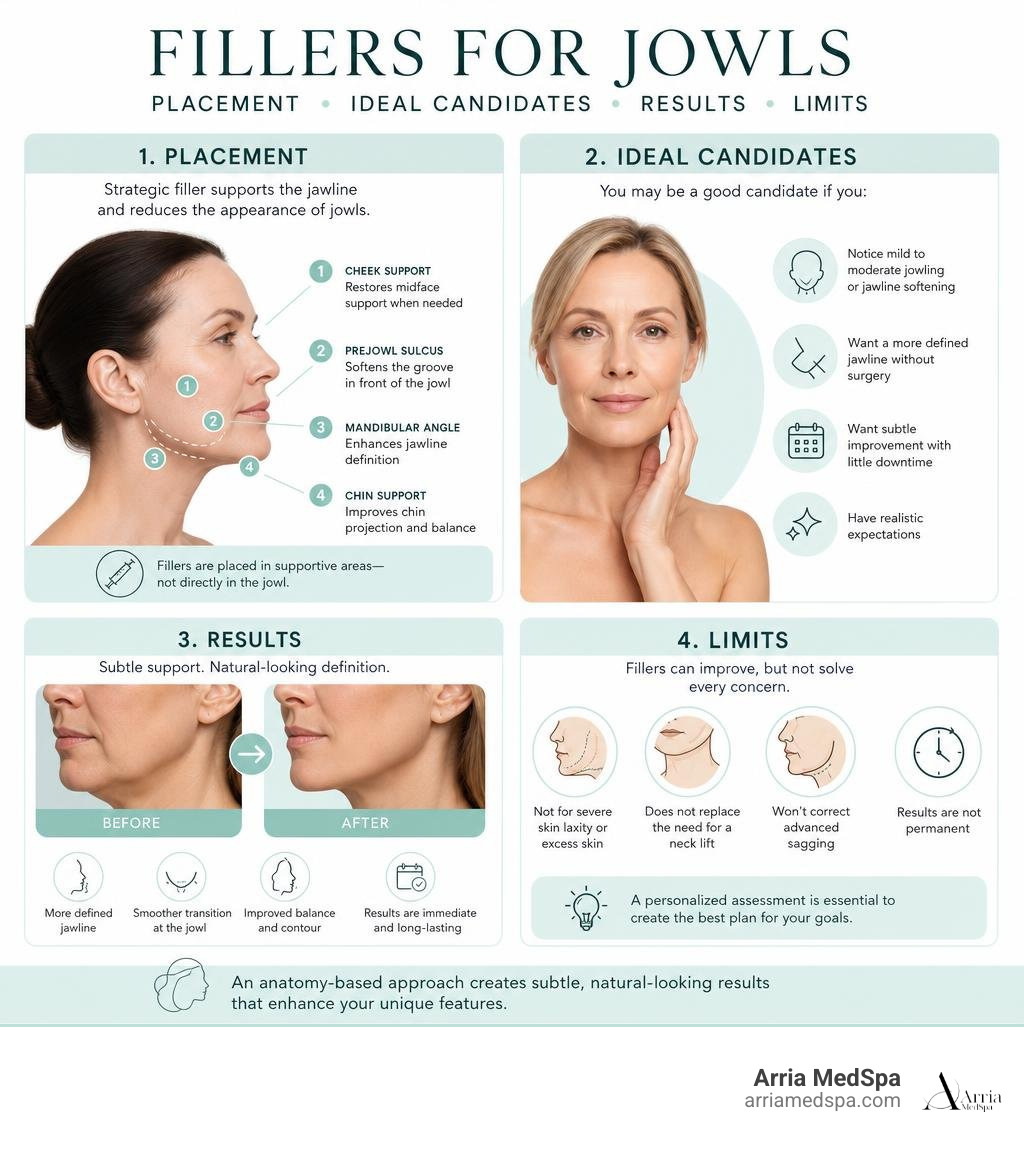
Fillers for jowls can improve mild to moderate lower-face sagging by rebuilding support along the jawline, chin, and hollows beside the jowl. Rather than adding filler into the sagging jowl itself, an experienced injector usually places structural filler in areas such as the mandibular angle, prejowl sulcus, and sometimes the cheek to create a smoother, more defined facial contour.
Jowls develop as skin loses elasticity, facial fat shifts downward, and the bone and supportive tissues of the lower face change with age. The right approach depends on where volume and support have been lost. For some people, jawline-focused filler is enough; others benefit from a broader plan that includes the chin, cheeks, skin-tightening treatments, or surgery for more advanced laxity.
I am Stephanie J. Rosen, a board-certified physician assistant with experience in plastic surgery, dermatology, and cosmetic medicine since 2005. My background in facial assessment and fillers for jowls helps guide a subtle, anatomy-based approach to lower-face rejuvenation.
The Anatomy of Jowls and Lower Facial Aging
Understanding why jowls appear begins with the underlying architecture of the face. Our skin rests on an intricate foundation composed of bone, muscles, retaining ligaments, and distinct fat compartments. The superficial musculoaponeurotic system (SMAS) connects facial muscles to the dermis, acting as a suspension network across the midface and neck.
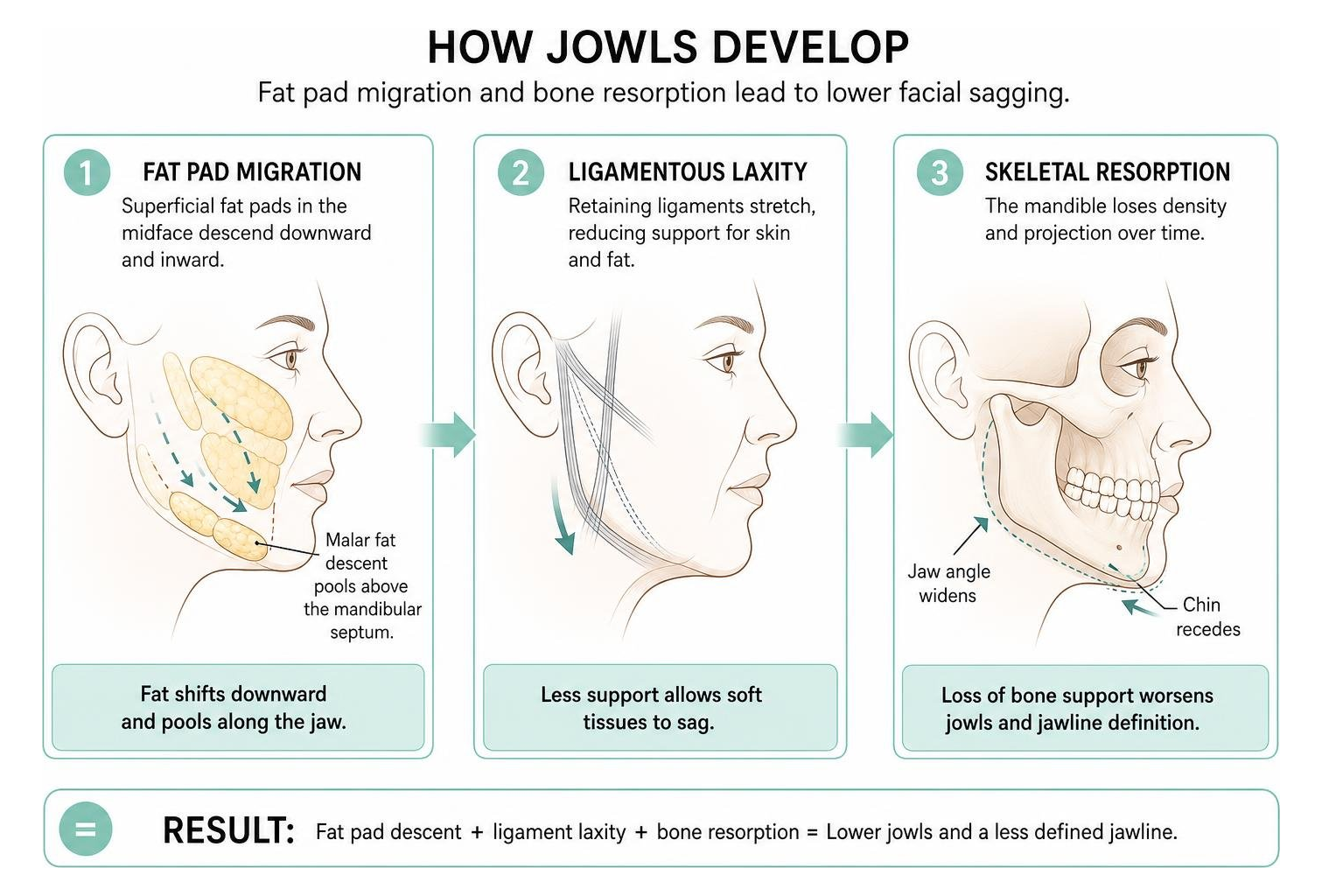
As we age, several interconnected anatomical changes occur simultaneously:
- Ligamentous Laxity: Deep retaining ligaments, including the zygomatic cutaneous and mandibular ligaments, gradually stretch. In the lower face, the tiny fibrous bands known as the retinacula cutis naturally allow skin mobility for chewing and speaking, making this region particularly prone to early gravitational descent.
- Fat Pad Migration: Superficial fat pads in the midface descend downward and inward. This malar fat descent pools above the mandibular septum, creating the characteristic bulge along the lower jaw.
- Skeletal Resorption: The mandible (jawbone) loses density and projection over time. The angle of the jaw widens, and the chin recedes slightly, depriving the overlying soft tissue of its structural scaffolding.
When these factors combine with reduced collagen and elastin production, the smooth line connecting the earlobe to the chin is interrupted. Incorporating comprehensive aging skin rejuvenation treatments helps address the surface texture, but structural volume loss demands deeper intervention.
How Dermal Fillers for Jowls Restore Lower Face Contour
Many patients assume that treating jowls involves injecting filler directly into the sagging tissue. However, doing so simply adds weight to an already heavy area, exacerbating ptosis. Instead, strategic placement of injectable hyaluronic acid dermal fillers works by camouflaging the depression in front of the jowl (the prejowl sulcus) and restoring the sharp edge of the posterior mandibular border.
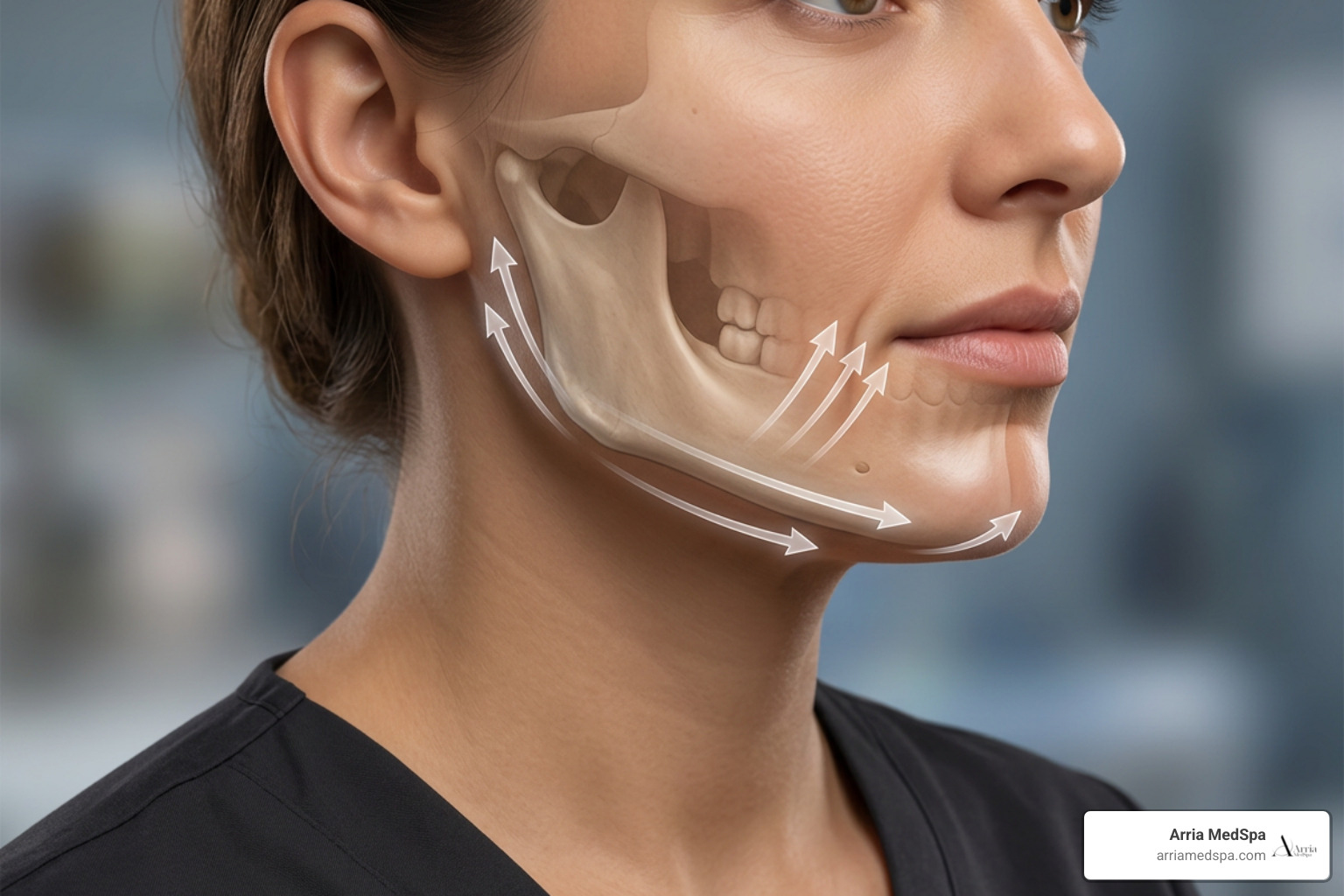
By reinforcing the mandibular angle and projecting the prejowl sulcus, we create a continuous, straight contour that conceals the jowl. Furthermore, treating extending marionette lines restores structural integrity around the mouth.
Clinical studies using validated metrics, such as the Merz Aesthetic Jawline Grading Scale (MAJGS), demonstrate remarkable improvements in jawline smoothness. Interestingly, clinical research evaluating isolated jawline injections versus combined cheek and jawline injections reveals important distinctions for treatment planning:
| Injection Approach | Average Product Volume (mL) | Primary Treatment Zones | Clinical Outcome on Jowl Severity |
|---|---|---|---|
| Mandibular Angle & Ramus Only | 3.36 mL | Jawline angle, mandibular ramus, prejowl sulcus | Statistically significant improvement assessed by blinded dermatologists and patients |
| Combined Cheek & Jawline | 8.38 mL | Lateral zygoma, malar apex, mandibular angle, prejowl sulcus | Noticeable midface volumization, but jawline-only jowl improvement did not achieve additional statistical superiority |
Targeted jawline injections alone often achieve exceptional lower-face contouring while minimizing total product volume.
Advanced Injection Vectors and the JOLT Protocol
For patients seeking comprehensive non-surgical lifting, advanced injection techniques may use targeted anatomical vectors to improve lower-face support and contour. Clinical research on the JOLT technique evaluated a multi-point hyaluronic acid filler approach designed to improve the appearance of jowls and create a smoother, more defined jawline.
The JOLT protocol involves specific sequential steps:
- Pyramid Technique: High G-prime filler is placed deeply onto the bone along the zygomatic arch to provide superior ligamentous tension.
- Platysma Auricular Fascia Lifting: A blunt 25-gauge cannula places retrograde threads of filler in the preauricular space, creating lateral vector traction across the lower face.
- Happy Face Technique & Labiomandibular Subcision: The cannula gently releases tethered fibrous bands around the marionette lines before filler is deposited to soften deep downturned mouth folds.
- Prejowl Sulcus Projection & Lateral Readjustment: High-density filler is placed supraperiosteally in the depression before the jowl and subdermally along a plane 2 to 3 mm below the anatomical border behind the jowl.
In peer-reviewed evaluations, subjects treated with this protocol experienced a significant drop in mean Jowl Appearance Scale (JAS) scores from 2.75 at baseline to 1.53 at 90 days. Investigator and patient Global Aesthetic Improvement Scale (GAIS) scores averaged 1.44, representing “very much improved” lower-face symmetry.
Expected Longevity, Dosage, and Treatment Protocol
Achieving optimal jawline definition requires sufficient structural support. The typical volume needed for lower-face contouring ranges from 3 to 7.5 mL total across full treatment plans, often divided over one or two sessions spaced four to six weeks apart.
Results from dense hyaluronic acid fillers generally last between 12 and 18 months, depending on your individual metabolic rate, product cross-linking, and lifestyle factors. When reviewing your overall budget and face filler injections cost 2026, maintenance sessions typically require far fewer syringes than initial foundational sculpting.
After treatment, minor localized swelling and bruising usually resolve within 5 to 7 days. A unique, transient side effect of deep supraperiosteal jawline injections is mild tenderness when chewing, which stems from product placement adjacent to the masseter muscle and resolves on its own within 2 to 3 days.
Comparing Product Formulations and Biostimulators
Not all fillers perform the same way in the lower face. Because the jawline requires rigid bone-mimicking support rather than soft, plush volumization, we select high G-prime formulations that resist deformation under muscular movement.
Best Hyaluronic Acid Fillers for Jowls
Hyaluronic acid remains the premier choice for jawline contouring due to its reversibility and immediate structural payout. Utilizing advanced VYC-20L cross-linking technology, products within the Juvederm benefits types recovery Montclair NJ portfolio—such as Juvéderm Volux XC and Voluma XC—offer high cohesivity and firm lift.
Similarly, firm-gel formulations discussed in our overview of Restylane benefits types recovery Montclair NJ (such as Restylane Contour and Lyft) provide precise projection when deposited deeply onto the periosteum. When reviewing our full menu of injectables/cosmetic fillers, our injectors assess your skin thickness to choose the gel matrix that integrates seamlessly with your tissues.
Calcium Hydroxylapatite and Collagen Stimulators
For patients with substantial skin laxity alongside volume loss, biostimulatory injectables offer durable, long-term regenerative benefits:
- Calcium Hydroxylapatite (CaHA): Products like injectables/radiesse provide immediate structural projection while stimulating natural neocollagenesis and elastin formation, tightening the tissue envelope over several months.
- Poly-L-Lactic Acid (PLLA): Collagen stimulators like injectables/sculptra rebuild deep dermal thickness and improve tissue density gradually across a series of sessions, creating a firmer base for the lower face.
Fillers vs. Surgical and Non-Surgical Alternatives
Deciding on the best path forward depends on the severity of tissue laxity, your aesthetic goals, and your comfort with downtime. Comparing non surgical vs surgical cosmetic procedures helps establish realistic expectations:
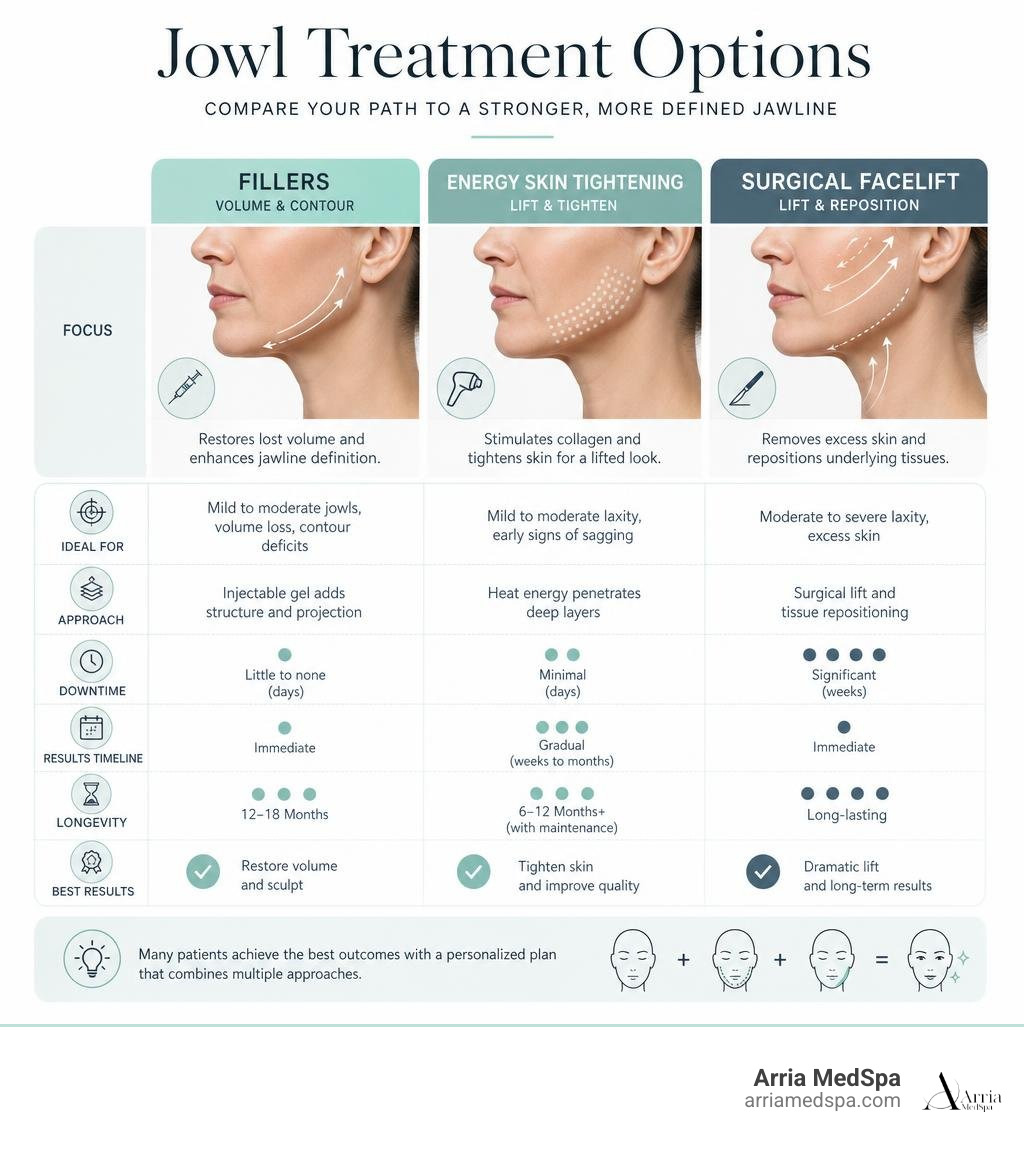
- Dermal Fillers: Excellent for masking mild-to-moderate jowls, restoring bone projection, and smoothing contour deficits with zero surgical incisions.
- Energy-Based Skin Tightening: Modalities such as microfocused ultrasound or radiofrequency heat the deep SMAS layer to induce tissue contraction, serving as a powerful companion to volume restoration.
- Liquid Facelifts: A comprehensive approach explained in our liquid facelift overview what to know, combining multi-plane fillers with neuromodulators to address the entire face in a single visit.
- Surgical Facelift & Neck Lift: The gold standard for advanced (Grade 4) laxity where excess skin must be excised and deep SMAS layers surgically repositioned.
Who Is an Ideal Candidate for Fillers for Jowls?
Dermal fillers provide exceptional outcomes for individuals with:
- Mild to moderate (Grade 2 to 3) jowls
- Visible hollows in the prejowl sulcus
- Good baseline skin elasticity without excessive skin redundancy
- Weak or receding chin projection
Contraindications include severe Grade 4 laxity, extremely heavy lower-face fat deposits, active skin infections, active blood-thinner regimens, and prior permanent silicone fillers in the treatment area. Patients with previous surgical SMAS manipulation require cautious, specialized anatomical evaluation.
Combining Modalities for Comprehensive Lower Face Harmony
The lower face and neck function as a unified aesthetic unit. Combining targeted jawline fillers with non surgical neck rejuvenation NJ creates seamless balance from the cheeks down to the collarbones.
Strategically placed injectables/botox relax hyperactive downward-pulling platysma bands and mentalis chin dimpling, allowing jawline fillers to project cleanly without muscular distortion.
Frequently Asked Questions About Lower Facial Rejuvenation
Can fillers lift severe jowling without surgery?
No. Fillers cannot cut away or physically reposition large amounts of loose skin. In cases of severe Grade 4 laxity, attempting to lift heavy jowls solely with filler can lead to an overfilled, bulky lower face. In these cases, a surgical lower facelift is the most appropriate solution.
Is tenderness when chewing normal after jawline filler?
Yes. Mild tenderness when chewing is a well-documented, temporary side effect that occurs when structural filler is placed deep along the mandibular angle, close to the insertion point of the masseter muscle. It typically resolves completely within 2 to 3 days.
Why shouldn’t filler be injected directly into the jowl fat pad?
Injecting product directly into the jowl adds weight to already descended soft tissue, making the jowl look heavier and more pronounced. Fillers are strategically placed in front of and behind the jowl to restore a straight, youthful jawline contour.
Choosing Expert Care for Your Lower Face at Arria MedSpa
Restoring a clean, crisp jawline requires an artistic eye and a deep understanding of facial anatomy. At Arria MedSpa in Montclair, NJ, we provide board-certified surgeon oversight to deliver personalized, natural-looking results tailored to your unique facial features.
Explore our comprehensive suite of skin rejuvenation treatments and schedule your consultation today to discover how subtle, strategic lower-face contouring can bring refreshed harmony to your profile.