

What Are Fillers — and Could They Be Right for You?
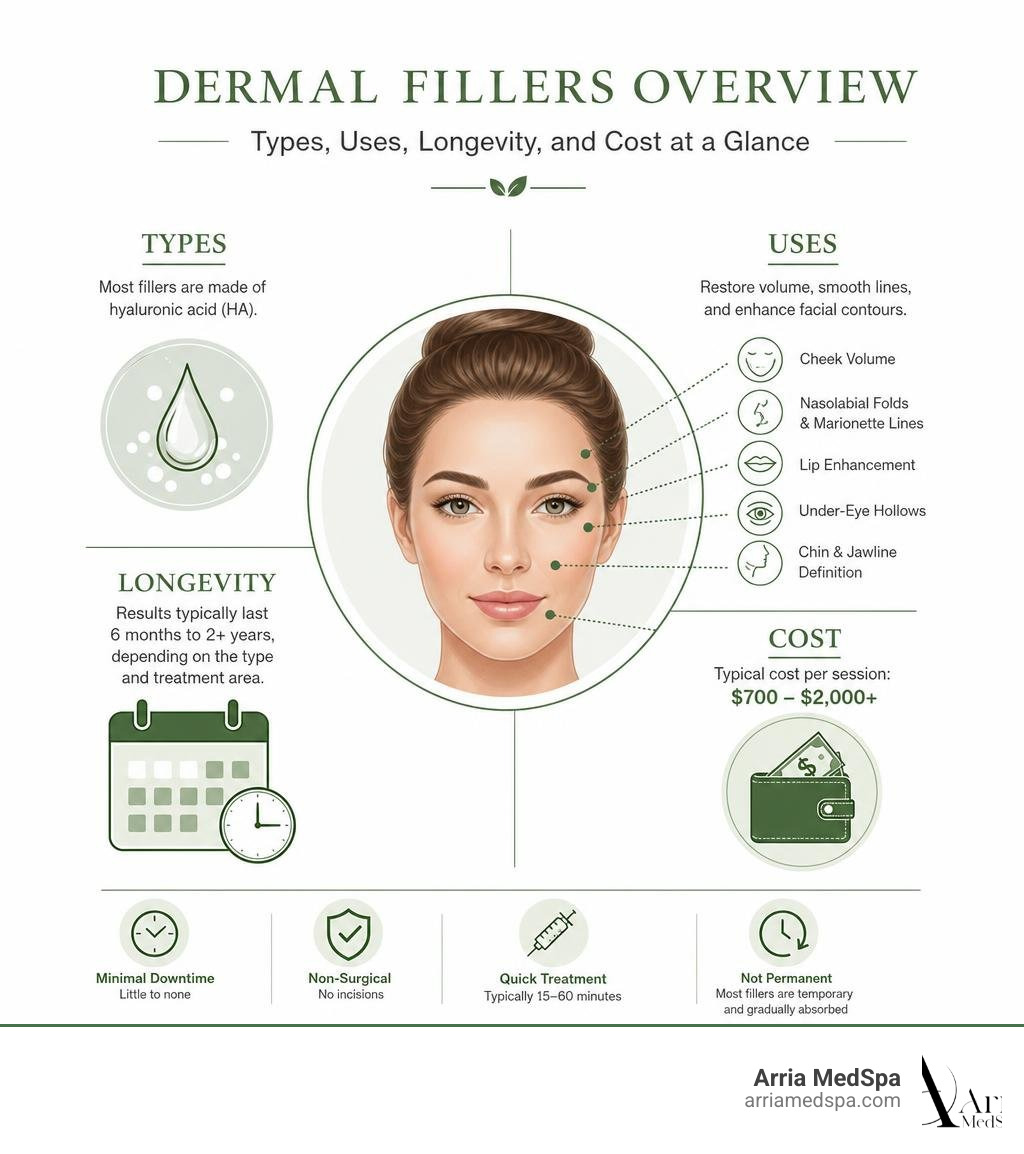
Fillers are gel-like substances injected beneath the skin to restore lost volume, smooth lines, and enhance facial contours — all without surgery.
Here is a quick overview:
| What you want to know | The short answer |
|---|---|
| What fillers do | Restore volume, smooth wrinkles, enhance lips and cheeks |
| How long results last | 6 months to 2+ years, depending on the type |
| Most common type | Hyaluronic acid (HA) |
| Typical cost | $700 – $2,000+ per session |
| Downtime | Little to none |
| Are they permanent? | No — most are temporary and gradually absorbed |
As we get older, our faces naturally lose fat, collagen, and elastin. Skin stretches. Cheeks hollow out. Lines appear where there were none before. It happens gradually — and for many women, it reaches a point where they want to do something about it without going under the knife.
That is exactly where dermal fillers come in. More than 3 million people in the United States choose filler treatments every year. The appeal is clear: fast results, minimal recovery, and no surgery required.
But with so many filler types, treatment areas, and providers to choose from, it helps to understand what you are actually getting into before you book an appointment.
I’m Stephanie J. Rosen, a board-certified Physician Assistant with over 20 years of experience in plastic surgery and dermatology, specializing in injectable treatments including Fillers. In this guide, I’ll walk you through everything you need to know — from how fillers work to what they can realistically achieve — so you can make a confident, informed decision.
Understanding Dermal Fillers and How They Work
To understand how dermal Fillers work, it helps to look at what happens under the surface of our skin as we age. When we are young, our skin is rich in collagen, elastin, and hyaluronic acid. These components work together to provide structure, elasticity, and hydration. Additionally, a youthful face has evenly distributed pockets of subcutaneous fat that create soft, rounded contours in the cheeks, temples, and under-eye areas.
With time, this youthful infrastructure begins to change. Starting in our mid-20s, our natural collagen depletion begins. The skin loses its springy resilience, and our bodies produce less hyaluronic acid, leading to a loss of natural moisture and skin thickness. At the same time, the subcutaneous fat pads in the face begin to shrink and shift downward due to gravity.
This loss of volume causes the skin to sag, making facial folds — such as the nasolabial folds running from the nose to the mouth — far more prominent. Hollows can develop under the eyes, and the cheeks may lose their youthful bounce.
Dermal fillers are designed to address this underlying volume loss. Unlike topical creams that only treat the surface of the skin, fillers are injected directly into or beneath the skin layers. They act as a supportive cushion, physically lifting the skin, smoothing out deep creases, and restoring the youthful fullness that has faded over time. To explore how these treatments fit into a broader aesthetic plan, you can read our guide on Injectable Treatments Explained.
By replenishing this lost volume, fillers do more than just “fill” wrinkles. They can reshape and contour facial features, giving our patients a refreshed, rested, and completely natural appearance. According to the medical experts at the Cleveland Clinic, these minimally invasive treatments provide immediate cosmetic improvements with minimal downtime. For a deeper look at the clinical definition of these treatments, you can read more about Dermal Fillers: What They Are, Types, Benefits & Side Effects.
The Most Popular Types of Injectable Treatments
Not all dermal Fillers are created equal. Different products are formulated with distinct active ingredients, gel densities, and levels of elasticity to target specific areas of the face.
When selecting a filler, our primary concern is biocompatibility — ensuring the substance is safe, well-tolerated by the body, and FDA-approved. The speed at which your body absorbs the gel, known as the absorption rate, also varies significantly depending on the chemical structure of the product.
To help you understand your options, we have compiled a quick reference table comparing the most common filler materials used today:
| Filler Type | Primary Material | How It Works | Typical Longevity | Best For |
|---|---|---|---|---|
| Hyaluronic Acid (HA) | Naturally occurring sugar gel | Attracts and binds water molecules | 6 to 18 months | Lips, cheeks, tear troughs, nasolabial folds |
| Calcium Hydroxylapatite (CaHA) | Mineral-like compound in gel | Provides immediate lift & stimulates collagen | 12 to 18 months | Deep wrinkles, jawline contouring, hands |
| Poly-L-lactic Acid (PLLA) | Biodegradable synthetic polymer | Gradually rebuilds natural collagen | 2+ years | Cheek volume, temples, facial wasting |
| Polymethylmethacrylate (PMMA) | Synthetic microspheres in collagen gel | Permanent support structure | Permanent | Deep nasolabial folds, acne scars |
Let’s dive deeper into these categories so you can understand which options might be discussed during a consultation at our Montclair, NJ office.
Hyaluronic Acid Fillers
Hyaluronic acid (HA) is by far the most popular category of dermal fillers. Because HA is a sugar molecule that occurs naturally within our own skin, these fillers boast an exceptional safety profile and are highly biocompatible. One of the greatest benefits of HA is its incredible capacity for water retention; a single molecule can hold up to 1,000 times its weight in water, helping to keep the treated area beautifully hydrated and plump.
At Arria MedSpa, we frequently utilize premium HA brands such as Juvederm and Restylane. These product families feature various formulations with different particle sizes. Larger, more robust gel particles are used to build up cheekbones, while softer, highly flexible gels are perfect for delicate lip enhancement.
If you want to explore how HA can restore your skin’s youthful structure, take a look at our detailed breakdown of Injectable Hyaluronic Acid Dermal Fillers. For those looking to smooth out facial lines and restore volume, you can learn more about Juvederm: The Aging Solution or read about the customization options in our article on Restylane Benefits, Types, Recovery Montclair NJ.
Synthetic and Biostimulatory Fillers
While HA fillers focus on immediate volume replacement using water-binding gels, biostimulatory fillers take a different approach. These synthetic fillers are designed to trigger your body’s natural healing cascade, prompting your fibroblasts to produce brand-new collagen over time.
- Calcium Hydroxylapatite (CaHA): Formulated as tiny calcium microspheres suspended in a smooth carboxymethylcellulose gel, CaHA provides an immediate lifting effect. Once the carrier gel naturally dissipates, the calcium particles remain to stimulate a firm network of new collagen. This makes it ideal for restoring structure to the jawline and hands. To understand how this unique biostimulator works, read our article on Injectables: Radiesse.
- Poly-L-lactic Acid (PLLA): This biodegradable substance has been used safely in medical devices, like dissolvable sutures, for decades. PLLA does not provide instant results; instead, it acts as a seed beneath the skin, gradually encouraging your body to rebuild its deep structural volume over several months. This results in incredibly natural-looking, long-lasting restoration for hollow temples and cheeks. You can find more details in our guide on Injectables: Sculptra.
What Injectable Treatments Can and Cannot Achieve

Managing expectations is a vital part of any cosmetic journey. Dermal Fillers are incredibly versatile, but they are not a universal cure-all for every sign of facial aging. Understanding the boundaries between non-surgical enhancements and surgical procedures ensures you achieve results you absolutely love.
What Dermal Fillers Can Do:
- Lip Augmentation: Fillers can beautifully plump thin lips, define a fading lip border, and smooth out vertical “smoker’s lines” around the mouth.
- Cheek and Temple Contouring: We can restore youthful curvature to sunken cheeks, soften hollow temples, and create the illusion of high, defined cheekbones.
- Softening Deep Folds: Fillers excel at smoothing out deep nasolabial folds (smile lines) and marionette lines (the creases running from the corners of the mouth down to the chin).
- Under-Eye Rejuvenation: By carefully placing filler in the tear troughs, we can minimize the dark shadows and tired hollows that make you look exhausted even after a full night’s sleep.
- Hands and Scars: Beyond the face, fillers can restore volume to aging hands to hide prominent veins and tendons, and lift recessed acne scars.
What Dermal Fillers Cannot Do:
While fillers can work wonders, they cannot replicate the dramatic lifting capacity of surgical procedures. If you have severe skin laxity, heavy jowls, or deeply sagging neck skin, a surgical facelift or neck lift may be the only way to achieve your desired outcome.
Fillers add volume; they do not remove or significantly tighten excess skin. Attempting to “lift” severe sagging by adding more and more filler can lead to an overfilled, unnatural appearance — often referred to as “filler fatigue” or the dreaded “pillow face.”
To help you decide which path is right for your unique anatomy, we have written an extensive comparison: Non-Surgical vs Surgical Cosmetic Procedures. Additionally, the Dermal Fillers | American Society of Plastic Surgeons resource provides an excellent overview of the clinical differences between these two approaches.
Frequently Asked Questions About Facial Rejuvenation
How long do injectable results typically last?
The longevity of your filler results depends on several key factors, including your individual metabolism, the specific treatment area, and the density of the product used.
Our bodies naturally produce an enzyme called hyaluronidase, which gradually breaks down HA fillers over time. If you have a highly active metabolism or exercise intensely, your body may process the filler slightly faster than average.
Furthermore, fillers tend to break down more quickly in highly mobile areas of the face — such as the lips and around the mouth — where constant talking, eating, and smiling move the gel. In contrast, fillers placed in static areas with less movement, such as the cheeks, temples, or tear troughs, typically last much longer.
Rest assured, modern fillers are highly durable, and getting treatments does not mean you will stretch out your skin. To put your mind at ease regarding long-term maintenance, you can read our reassuring article, Do Fillers Ruin Your Face?.
What are the potential risks and side effects?
When performed by a highly trained medical professional, dermal filler treatments are exceptionally safe. However, like any medical procedure, they carry some potential risks.
The most common side effects are mild and temporary, typically resolving within 3 to 7 days:
- Bruising and Swelling: Some minor swelling and bruising at the injection site are completely normal.
- Redness and Tenderness: The treated area may feel slightly tender or look pink immediately after your session.
- Asymmetry: Minor asymmetry can occur, which is easily corrected during a brief follow-up touch-up once the initial swelling has completely subsided.
A rare but serious complication is vascular occlusion, which occurs if filler is accidentally injected into a blood vessel, blocking blood flow to the surrounding tissue. This is why choosing an injector with deep anatomical knowledge is absolutely critical.
At Arria MedSpa, our injectors are fully trained in advanced safety protocols and keep dissolving agents on hand to immediately reverse HA fillers if any signs of vascular compromise occur. You can review the safety standards and clinical guidelines outlined by the Facial fillers for wrinkles – Mayo Clinic to learn more about minimizing treatment risks.
How much do injectable treatments cost?
The total cost of your dermal filler treatment is highly customized. It depends primarily on the number of syringes required to achieve your aesthetic goals, the specific brand of filler selected, the expertise of your provider, and our geographic location here in northern New Jersey.
During your personalized consultation, we will map out a precise treatment plan tailored to your budget and goals. To help you plan your visit, we have provided an up-to-date pricing guide in our article, Face Filler Injections Cost 2026.
Start Your Journey to Natural-Looking Radiance
Achieving beautiful, natural-looking results with dermal Fillers requires a delicate balance of medical expertise and artistic skill. At Arria MedSpa in Montclair, NJ, we pride ourselves on providing exceptional patient care under the diligent oversight of our board-certified surgeon. We believe that the best cosmetic work is invisible — leaving you looking refreshed, youthful, and completely like yourself.
Whether you are visiting us from nearby Bloomfield, Glen Ridge, Verona, Cedar Grove, Clifton, or Nutley, our team is ready to design a personalized treatment plan just for you. We will take the time to evaluate your unique facial structure, listen to your aesthetic goals, and answer any questions you may have.
Are you ready to restore your youthful glow and boost your confidence? Schedule a skin treatment consultation with our expert team at Arria MedSpa today, and let us help you put your best face forward.