

Fuller, More Youthful Lips: Your Lip Augmentation Options at a Glance
Lip augmentation is a cosmetic procedure that adds volume, shape, and definition to the lips — and there are several ways to achieve it, from quick in-office injections to longer-lasting surgical options.
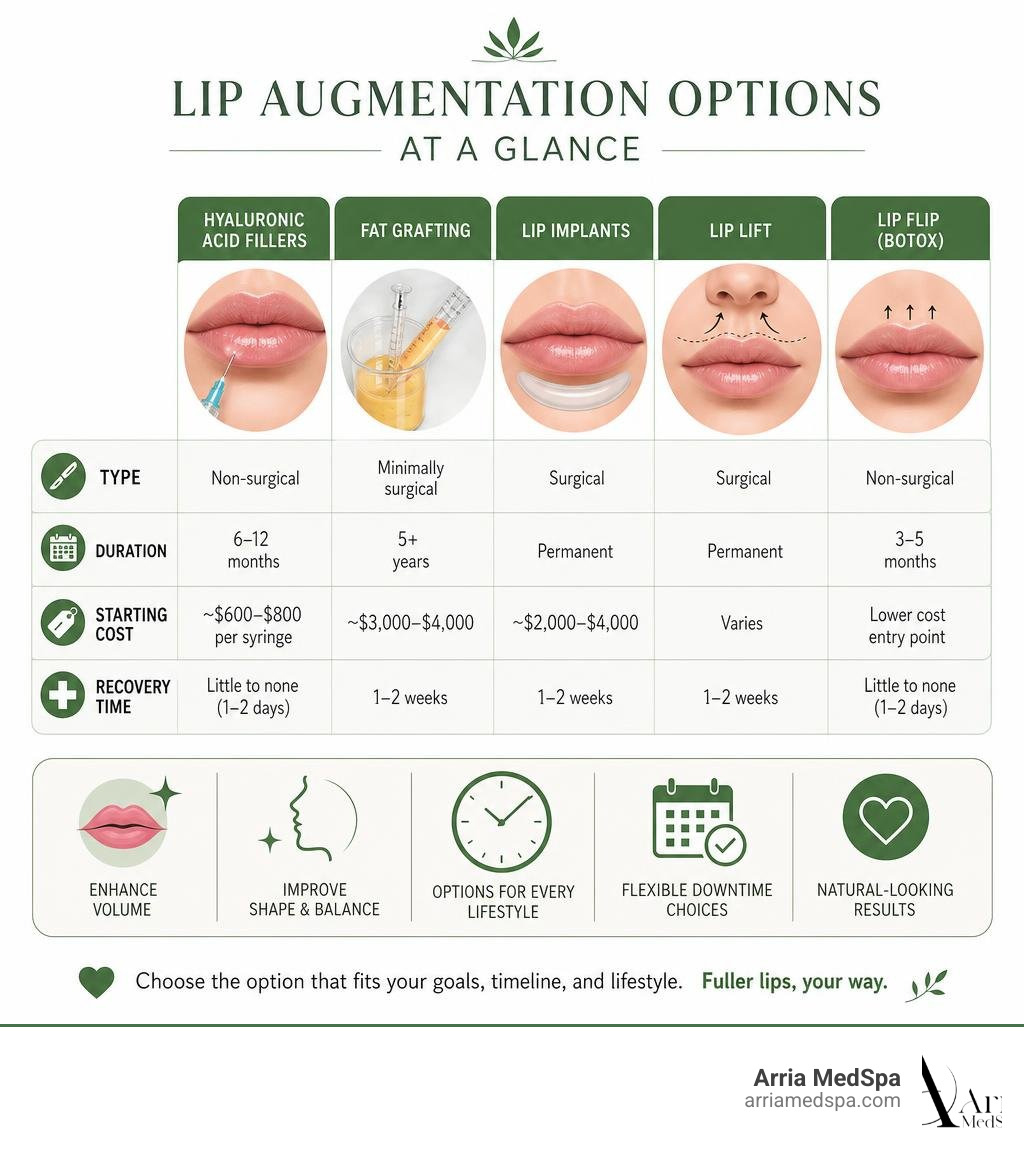
Here is a fast overview of the most common choices:
| Option | Type | Duration | Starting Cost |
|---|---|---|---|
| Hyaluronic acid fillers | Non-surgical | 6–12 months | ~$600–$800/syringe |
| Fat grafting | Minimally surgical | 5+ years | ~$3,000–$4,000 |
| Lip implants | Surgical | Permanent | ~$2,000–$4,000 |
| Lip lift | Surgical | Permanent | Varies |
| Lip flip (Botox) | Non-surgical | 3–5 months | Lower cost entry point |
Over 1.4 million people had a lip enhancement procedure in 2024 — and it is easy to see why. Full lips are widely associated with youth and vitality, and today’s options make it more accessible than ever to achieve natural-looking results with little to no downtime.
Whether you have always had thin lips, are noticing volume loss with age, or simply want better balance and symmetry in your face, there is likely an approach that fits your goals and your schedule.
I’m Stephanie J. Rosen, a board-certified Physician Assistant with over 20 years of experience in plastic surgery and dermatology, including extensive hands-on work with lip augmentation treatments. In this guide, I’ll walk you through everything you need to know to choose the right option for your goals.
Lip augmentation word guide:
What is Lip Augmentation and Who is It For?
At its core, lip augmentation is a highly customizable cosmetic treatment designed to restore or enhance the volume, structure, and border of your lips. While pop culture might make you think it is only about creating dramatic “plumpness,” the reality is much more subtle. For the vast majority of our patients here in the Montclair, NJ area, the goal is to establish harmony, smooth out fine lines, and recreate a youthful structure that has softened over time.

As we age, our bodies naturally produce less collagen and hyaluronic acid. In the perioral (mouth) area, this biological slowdown manifests as:
- Thinning lips that seem to “disappear” or roll inward, especially when we smile.
- Asymmetry, where one side of the lip or the upper lip is noticeably smaller or uneven compared to the other.
- Dehydration and vertical lip lines, often referred to as “smoker’s lines,” which can cause lipstick to bleed.
- A flattened Cupid’s bow and fading borders, which make the lips lose their distinct, youthful frame.
- Downturned corners of the mouth, which can inadvertently create a sad or tired resting expression.
So, who is the ideal candidate for lip enhancement? You might be a great candidate if you are in good general health, do not have active oral infections (like a cold sore breakout), and want to address thinness, asymmetry, or age-related volume loss. It is also an excellent option for men—in fact, male lip augmentation has increased an incredible 445% since 2000!
When evaluating your lips, we look closely at facial balance. A classic aesthetic standard is the “golden ratio” of the lower third of the face, where the lower lip is ideally about 1.6 times fuller than the upper lip (a 1:1.6 ratio). However, we also customize this based on individual anatomy and background. For instance, different ethnic backgrounds have unique, beautiful baseline proportions that we always aim to respect and enhance rather than erase.
To help you visualize the basic differences between the two most popular non-surgical paths, here is a quick comparison:
| Feature | Hyaluronic Acid Dermal Fillers | Botox Lip Flip |
|---|---|---|
| Primary Goal | Adds physical volume, structure, and hydration | Relaxes muscles to roll the lip outward |
| Ideal For | Thin lips, deep lines, asymmetry, and flat borders | Subtle “pouty” look without added volume |
| Treatment Time | 15 to 30 minutes | 5 to 10 minutes |
| Longevity | 6 to 12 months | 3 to 5 months |
To learn more about how we customize these treatments to match your unique anatomy, explore our detailed guide on How Can I Make My Lips Fuller?. For a broader medical perspective on both surgical and non-surgical approaches, you can also read the Cleveland Clinic lip augmentation overview.
When deciding on a treatment path, it is incredibly helpful to weigh the pros and cons of temporary versus permanent options. We break down these differences thoroughly in our article on Non-Surgical vs Surgical Cosmetic Procedures to help you make an informed decision.
Non-Surgical Options: Dermal Fillers and Injectables
For patients seeking immediate results with minimal disruption to their daily routines, non-surgical lip augmentation is the gold standard. These treatments are performed right in our comfortable Montclair office and allow you to get back to your life almost immediately.
Through the strategic use of Injectables and Injectables Cosmetic Fillers, we can target specific concerns with pinpoint accuracy. Whether you want to restore lost volume, define a blurry lip border, lift downturned corners, or smooth out stubborn vertical lines, non-surgical techniques offer unparalleled control.
Hyaluronic Acid Fillers for Lip Augmentation
The absolute favorite material for modern lip fillers is hyaluronic acid (HA). Hyaluronic acid is a naturally occurring sugar molecule in your body that binds to water, keeping your tissues hydrated, plump, and elastic. Because HA fillers are biocompatible, the risk of an allergic reaction is exceptionally low. Even better, they are completely reversible using an enzyme called hyaluronidase—offering peace of mind for patients who might be nervous about trying a new look.
In our practice, we utilize the most advanced, FDA-approved HA fillers on the market to craft natural-looking results:
- The Juvéderm Family: Products like Juvéderm Ultra XC are fantastic for adding plush, soft volume and structure. For those wanting an ultra-subtle, hydrated look without a massive increase in size, Juvéderm Volbella XC is a thin, smooth gel perfect for superficial lip lines and delicate border definition. To learn more about how these products work and what to expect, check out our guide on Juvederm Benefits Types Recovery Montclair NJ.
- The Restylane Family: Restylane Kysse is specifically engineered with “XpresHAn Technology,” allowing the filler to bind to your natural lip tissue so it moves seamlessly when you talk, laugh, and smile. Restylane Silk is another excellent, lightweight option designed specifically for fine lines around the mouth. You can read more about these options in our article on Restylane Benefits Types Recovery Montclair NJ.
To dive deeper into how HA fillers behave in the delicate perioral tissue, you can read the comprehensive clinical review on Lip Augmentation With Hyaluronic Acid Fillers: A Review of Considerations and Techniques – JDDonline – Journal of Drugs in Dermatology. For a more detailed breakdown of HA options, explore our page on Injectable Hyaluronic Acid Dermal Fillers.
Alternative Injectables and Lip Augmentation Techniques
Beyond standard filler injections, aesthetics has seen incredible technological and methodological advancements. We no longer just “fill” the lips; we sculpt them using advanced mathematical and anatomical frameworks.

One popular alternative is the Botox Lip Flip. Instead of adding physical volume, we inject tiny, precise doses of a neuromodulator (like Botox or Dysport) into the orbicularis oris muscle just above the upper lip border. This relaxes the muscle fibers that pull the lip downward, allowing the upper lip to gently roll upward and outward. The result is a gorgeous, subtle pout that makes the upper lip look fuller without adding any actual volume. This is often an ideal starting point for patients who want to “test the waters” of lip enhancement. Learn more about how neuromodulators fit into your aesthetic journey by reading 5 Types of Injectables for Facial Enhancement.
We also stay at the forefront of advanced injection methodologies. As detailed in the Advancements in lip augmentation: A scoping review exploring novel techniques – PMC, several innovative techniques have revolutionized how we achieve natural results:
- The Philtral Columns Technique: Injecting microscopic amounts of filler vertically into the philtral ridges (the two lines running from your nose to your Cupid’s bow) gently lifts the center of the upper lip for a refined, youthful projection.
- The Step-by-Step Phi Technique: A gradual approach based on the golden ratio (1.618) that builds volume over multiple sessions, preventing the overfilled look.
- The French Kiss and Four-Point Techniques: Standardized injection algorithms designed to maximize patient comfort and structural support while minimizing swelling and bruising.
- PDO Smooth Threads: Placed along the vermilion border, these absorbable threads stimulate your body’s own collagen production, defining the lip line and softening stubborn vertical wrinkles without adding bulk.
What to Expect: Recovery, Risks, and Results
We believe that a well-informed patient is a happy patient. Knowing exactly what to expect before, during, and after your lip augmentation ensures a smooth recovery and stunning, stress-free results.
The Procedure: A typical lip filler session takes only 15 to 30 minutes. We begin by applying a medical-grade topical numbing cream to ensure your comfort. Most modern fillers also contain lidocaine (a local anesthetic) mixed directly into the gel, meaning the area becomes progressively numb as the treatment proceeds. We use ultra-fine needles or micro-cannulas to place the filler precisely where it is needed.
The Recovery Timeline:
- Days 1–2: Swelling is completely normal and should be expected. Because the lips are incredibly vascular, they react quickly to the physical injection. You may also experience minor bruising, redness, and tenderness.
- Days 3–5: Swelling begins to subside significantly. Any minor asymmetry caused by uneven swelling will start to resolve.
- Weeks 2–4: The filler integrates beautifully with your natural lip tissue. By the end of week four, the product has fully settled, and you will see your final, soft, natural-looking results.
Actionable Aftercare Steps for a Speedy Recovery:
- Ice, Ice, Baby: Apply a cold pack wrapped in a clean cloth to your lips for 10 minutes at a time during the first 24 to 48 hours to minimize swelling.
- Elevate Your Head: Use an extra pillow to keep your head elevated while sleeping for the first night or two.
- Eat Soft Foods: Stick to easy-to-chew foods (like yogurt, pudding, or smoothies) for the first day, and avoid hot, spicy, or overly salty foods that could irritate the lips.
- Avoid Strenuous Exercise: Skip the heavy gym sessions, saunas, and steam rooms for at least 24 to 48 hours post-treatment, as increased blood flow can worsen swelling.
- Pre-Treatment Prep: Stop taking blood-thinning supplements like fish oil, vitamin E, aspirin, and ibuprofen a week before your appointment (with your doctor’s approval) to minimize bruising. If you have a history of cold sores, let us know beforehand so we can prescribe a preventative antiviral medication.
If you have ever wondered about the safety of these treatments or feared the dreaded “duck lips,” we address these worries head-on in Do Fillers Ruin Your Face?. Additionally, if your primary goal is to smooth out the delicate skin surrounding the mouth, read our specialized guide on Lip Injections for Lip Lines.
Frequently Asked Questions About Lip Enhancement
We hear many of the same questions from our patients in Montclair and surrounding Essex County towns. Here are the clear, honest answers you need.
How long do lip fillers typically last?
On average, hyaluronic acid lip fillers last between 6 and 12 months.
However, the exact lifespan of your filler depends on several factors:
- Your Metabolism: The lips are constantly moving when we talk, eat, and smile. If you have a fast metabolism, your body may break down the hyaluronic acid slightly faster.
- The Product Used: Firmer, more cross-linked fillers (like Restylane Kysse or Juvéderm Ultra Plus) tend to last longer than softer, thinner formulas designed purely for hydration.
- Your Treatment History: Patients who maintain their fillers consistently often find that subsequent treatments last longer as a baseline of collagen is built up over time.
For more detailed answers on maintaining your results, check out our Restylane lip filler FAQs.
What are the potential side effects of lip fillers?
When performed by an experienced, qualified medical provider, lip fillers are incredibly safe. However, like any medical treatment, they carry some potential side effects.
Common, Temporary Side Effects:
- Swelling and redness at the injection sites.
- Minor bruising and tenderness.
- Temporary lumps or firm areas as the filler settles (these can easily be massaged out by your provider at your follow-up).
Rare, Serious Risks:
- Allergic Reactions: Extremely rare with modern HA fillers.
- Infection: Prevented by maintaining strict sterile techniques during injection.
- Vascular Occlusion: This is the most serious risk, occurring if filler is accidentally injected into a blood vessel. If left untreated, it can cause tissue damage.
This is precisely why choosing an injector with deep anatomical knowledge is vital. A highly trained provider knows how to spot a vascular event instantly and can immediately dissolve the filler using hyaluronidase to prevent any complications. For a comprehensive look at the clinical safety profiles and surgical implant risks, you can review the Lip Implants – StatPearls – NCBI Bookshelf.
How much does lip enhancement cost?
The cost of lip augmentation varies based on the method you choose, the geographic location of the practice, and the expertise of your provider.
Here is a general look at typical market ranges:
- Hyaluronic Acid Fillers: Usually range from $600 to $800 per syringe. Most patients achieve their desired look with just one syringe, though some may choose a second syringe over time for more significant volume.
- Fat Grafting: Typically costs between $3,000 and $4,000 because it involves a minor surgical harvesting step.
- Lip Implants: Usually range from $2,000 to $4,000 for a permanent, surgical solution.
- Tissue Grafting: Can range from $3,000 to $6,000.
At Arria MedSpa, we believe in complete transparency. During your personalized consultation, we will provide a detailed cost breakdown tailored to your specific treatment plan, ensuring there are never any surprises.
Your Next Step Toward Fuller Lips
Your lips are one of the most expressive features on your face. Whether you want to restore the soft, hydrated volume of your youth, correct a lifetime of asymmetry, or simply add a subtle, beautifully defined border, lip augmentation offers a safe and highly effective path to boosting your confidence.
At Arria MedSpa in Montclair, NJ, we combine the safety and precision of board-certified surgeon oversight with an artistic eye for natural-looking results. We serve patients from all across our local communities—including Glen Ridge, Clifton, Nutley, Little Falls, West Orange, and Millburn—providing personalized care that honors your unique facial structure. We never believe in a “one-size-fits-all” approach; instead, we work closely with you to design a subtle, stunning look that is uniquely yours.
Ready to take the first step toward your perfect pout? Schedule a personalized consultation with us today and let us help you achieve lips that look natural, feel soft, and make you smile.