
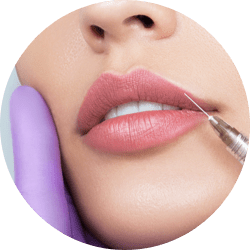
Why Lip Augmentation Techniques Matter More Than You Think
Lip augmentation techniques have become one of the most requested aesthetic treatments in the U.S. — and for good reason. Whether you want subtle definition, a softer pout, or a more youthful shape, the method your injector uses matters just as much as the filler itself. For patients concerned about fine wrinkles around the mouth, combining fillers with laser resurfacing lip lines can provide a comprehensive rejuvenation.
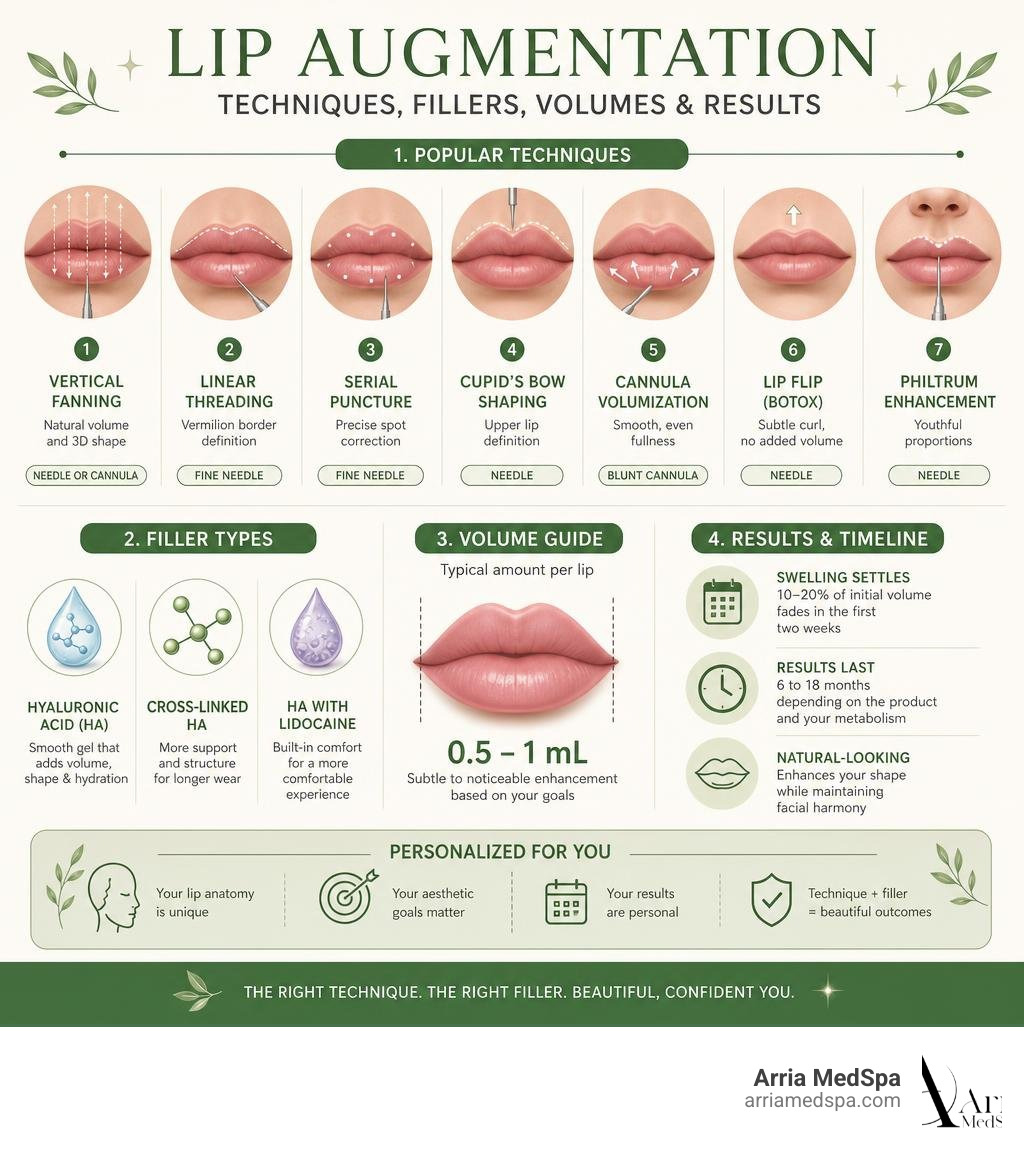
Here is a quick overview of the most common techniques:
| Technique | Best For | Tool Used |
|---|---|---|
| Vertical fanning | Natural volume and 3D shape | Needle or cannula |
| Linear threading | Vermilion border definition | Fine needle |
| Serial puncture | Precise spot correction | Fine needle |
| Cupid’s bow shaping | Upper lip definition | Needle |
| Cannula volumization | Smooth, even fullness | Blunt cannula |
| Lip flip (Botox) | Subtle curl, no added volume | Needle |
| Philtrum enhancement | Youthful proportions | Needle |
Most patients receive 0.5 to 1 mL of filler per lip, and about 10–20% of the initial volume fades within the first two weeks as swelling settles. Results typically last 6 to 18 months, depending on the product and your metabolism.
The right technique depends on your lip anatomy, your aesthetic goals, and how your lips have changed with age. This guide walks you through everything — from the science behind fillers to what actually happens during and after treatment.
I’m Stephanie J. Rosen, a board-certified Physician Assistant with nearly two decades of experience in plastic surgery and dermatology, including lip augmentation techniques across a wide range of patient needs. I’ll walk you through what the research says and what actually works in practice.
Understanding Perioral Anatomy and the Aging Process
Successful lip enhancement is never a one-size-fits-all procedure. Achieving beautiful, balanced results requires an intimate understanding of the perioral framework and how light interacts with the curves of the mouth. Every injection we perform is guided by the Universal Lip Integrity framework, which prioritizes structural support and natural proportions over simple overfilling.
Key Structures of the Lips and Philtrum
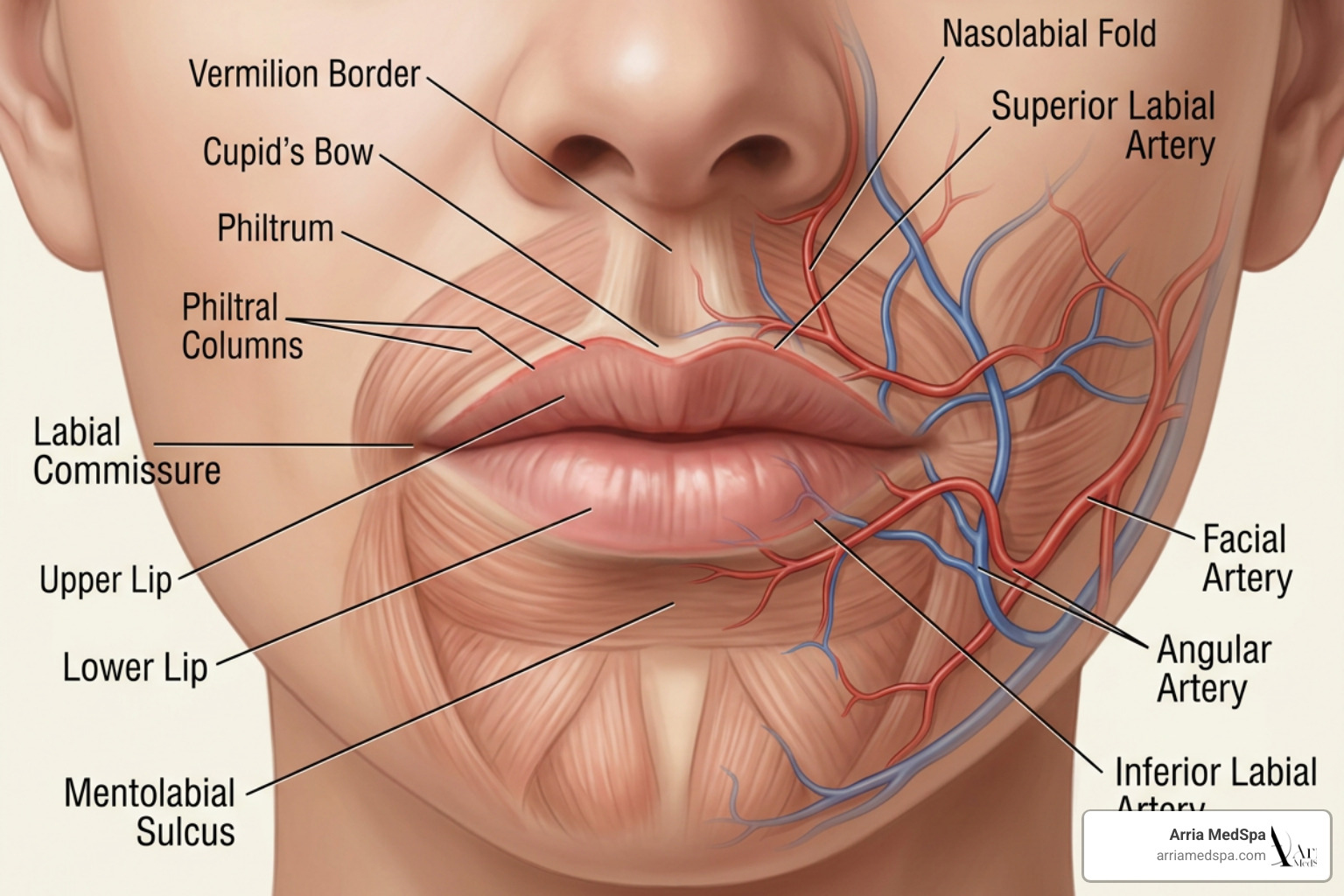
The lips are composed of highly specialized tissues with distinct borders. The vermilion border is the sharp line separating the pink lip (dry mucosa) from the surrounding skin, highlighted by a subtle pale border known as the white roll. At the center of the upper lip lies the Cupid’s bow, characterized by two distinct peaks that connect upward to the base of the nose via the philtral columns.
Beneath the surface sits the orbicularis oris muscle, a circular muscle that controls lip movement and speech. When we perform lip augmentation, we target specific depths relative to this muscle. The transition zone where the dry mucosa meets the wet, internal lining of the mouth is called the wet-dry border, which serves as a crucial landmark for placing volume without creating unnatural bulges.
How Aging Alters Lip Volume and Proportions
As we age, our lips undergo predictable structural changes. The body’s natural production of collagen and hyaluronic acid slows down, leading to noticeable volume loss. This structural depletion causes the vermilion border to thin and blur, while the once-defined philtral columns begin to flatten. The corners of the mouth (oral commissures) often descend, giving the face a resting down-turned appearance.
Furthermore, the distance between the nose and the upper lip elongates, causing the red lip to roll inward (invert). These changes require a restorative approach rather than simple volumization. We also account for ethnic and cultural variations; for instance, while classic Caucasian proportions often favor an upper-to-lower lip ratio of 1:1.6 (the golden ratio), many Asian and Black patients naturally possess and prefer a 1:1 ratio. Tailoring our approach to these unique differences ensures that every treatment looks beautifully harmonious.
The Science of Lip Fillers: Hyaluronic Acid and Advanced Formulations
Modern dermal fillers are highly sophisticated, biocompatible gels designed to integrate seamlessly into dynamic facial tissues. Hyaluronic acid (HA) remains the gold standard for lip treatments because it is naturally present in the human body, exceptionally cohesive, and fully reversible with the enzyme hyaluronidase.
| Filler Product | Rheological Profile | Ideal Use Case | Expected Longevity |
|---|---|---|---|
| Restylane Kysse | High flexibility, moderate G-prime | Natural movement, soft volume | 9 to 12 months |
| Juvederm Ultra | High cohesivity, moderate firmness | Dramatic volume, structural support | 6 to 12 months |
| Juvederm Volbella | Low viscosity, soft integration | Fine lines, subtle hydration | 12 months |
| Restylane Silk | Ultra-fine particles, low G-prime | Superfine border definition, lip lines | 6 months |
Comparing Hyaluronic Acid Dermal Fillers
Choosing the right filler requires balancing specific physical properties, such as G-prime (hardness) and viscosity (flowability). Products like Juvederm and Restylane are formulated differently to achieve distinct outcomes. High G-prime fillers provide strong structural support and are excellent for building projection, whereas low G-prime fillers are softer and integrate easily into superficial tissue for a smooth, hydrated look.
According to the clinical guide on dermal fillers, matching the correct product to the patient’s tissue thickness is vital. If a filler is too firm, it can feel lumpy and restrict natural movement; if it is too soft, it may fail to provide the lift needed to correct deep lines or structural deflation.
Advanced Lip Augmentation Techniques for Custom Results

Aesthetic medicine has evolved far beyond simple border-running injections. Today, we utilize highly precise, multidimensional methods to sculpt the lips while preserving their natural movement. The groundbreaking 4D Lips Technique guides our approach by focusing on four essential pillars: dimension, distribution, dynamics, and desire.
Precision Shaping with Vertical Fanning Lip Augmentation Techniques
Vertical fanning is an advanced method where the injector inserts the needle vertically from the border toward the wet-dry junction, placing tiny microdroplets of filler as the needle is withdrawn. This creates a series of vertical pillars that gently evert the lip outward rather than pushing it forward.
This controlled dispersion prevents the filler from pooling horizontally, which is the primary cause of the dreaded “duck lip” projection. By working along the vertical axis, we can increase the visible height of the red lip (lip show) while maintaining a flat, natural profile in three-dimensional space.
Defining the Cupid’s Bow and Creating Upturned Corners
To restore a youthful, crisp shape to the upper lip, we focus on the Cupid’s bow and the oral commissures. A Cupid’s bow lift involves placing microscopic amounts of filler along the peaks of the white roll to enhance definition and catch the light beautifully.
For downturned corners, we perform a non-surgical corner lip lift. By injecting filler immediately below the oral commissure, we create a supportive cushion that elevates the corners of the mouth back to a neutral, pleasant position. This technique works hand-in-hand with targeted treatments such as lip injections for lip lines to smooth out the entire perioral area.
Dynamic Layering and Combination Lip Augmentation Techniques
Achieving the most natural results often requires combining different modalities. We can pair dermal fillers with neuromodulators like Botox to perform a “lip flip.” By injecting a few units of Botox into the orbicularis oris muscle, we relax the muscle fibers that pull the lip inward, allowing the upper lip to gently roll upward and reveal more pink tissue without adding volume.
We also perform philtrum enhancement by placing subtle lines of soft filler along the philtral columns, recreating the youthful contour that naturally flattens over time. These combined strategies are among the most popular medspa injectables because they address multiple signs of aging in a single, cohesive session.
Needle vs. Cannula: Choosing the Right Tool for Precision and Safety
The choice of injection tool is a critical decision that influences both the aesthetic outcome and the recovery experience. As detailed in the recent scoping review on lip augmentation advancements, both needles and cannulas have distinct advantages depending on the specific treatment area.
Needle Techniques for High-Definition Borders
Fine-gauge needles offer unmatched precision for defining sharp borders and detailed structures like the Cupid’s bow. Techniques such as linear threading (depositing a continuous line of filler as the needle is withdrawn) and serial puncture (placing precise, separate microdroplets) allow us to place product with millimeter-level accuracy.
The primary trade-off with needles is a higher risk of bruising and swelling, as the sharp tip can easily nick tiny blood vessels within the delicate lip tissue.
Cannula Techniques for Smooth Volumization
Blunt-tipped cannulas are flexible, thin tubes that require a single entry point made by a pilot needle. Because the tip is blunt, the cannula pushes past blood vessels and nerves rather than cutting through them, significantly reducing tissue trauma, bruising, and discomfort.
We often favor cannulas for deep, uniform volumization across the body of the lip. To understand more about how these delivery systems work, you can explore how different injectable treatments explained can be customized to your comfort levels.
Safety First: Preventing and Managing Lip Filler Complications
Patient safety is our absolute priority. While lip injections are incredibly popular, they are medical procedures that require expert anatomical knowledge to avoid serious complications. Utilizing 5 types of injectables effectively across the face demands a deep understanding of facial danger zones.
Navigating High-Risk Vascular Zones
The lips are highly vascular, supplied primarily by the superior and inferior labial arteries. These vessels typically run within the submucosal plane, deep to the orbicularis oris muscle. However, their depth can vary, making deep injections highly risky.
To minimize the risk of vascular compromise (where filler accidentally blocks a blood vessel), we inject superficially in the subcutaneous or intradermal planes, always aspirating for several seconds before releasing any product to ensure the needle tip is not inside an artery.
Step-by-Step Protocol for Adverse Events
In the rare event of a vascular occlusion, immediate action is required. We maintain a strict medical protocol that includes:
- Immediately halting the injection at the first sign of skin blanching (whitening) or localized pain.
- Flooding the affected area with high doses of hyaluronidase to rapidly dissolve the HA filler.
- Applying warm compresses and vigorously massaging the tissue to encourage blood flow.
- Monitoring capillary refill time to ensure normal circulation returns.
For non-emergency issues like minor nodule formation, we can gently massage the area or use micro-doses of hyaluronidase to smooth out any persistent lumps.
What to Expect: Recovery, Maintenance, and Staged Treatments
Managing expectations is a key part of the aesthetic journey. Lips are highly sensitive and prone to temporary swelling, which is a completely normal response to the procedure.
Managing Swelling and Volume Settling
Immediately after your treatment, your lips will look significantly fuller than your final result. Approximately 10% to 20% of this initial volume is temporary swelling, which typically peaks within 24 to 48 hours and subsides fully over the next one to two weeks.
We recommend applying cold compresses gently to the area and avoiding intense exercise, alcohol, and extreme heat for the first 24 hours. For more practical recovery tips, you can read our Restylane FAQs to help guide you through the post-treatment phase.
Future Innovations in Lip Enhancement
The field of perioral rejuvenation continues to advance rapidly. We are seeing the development of highly dynamic fillers that stretch and compress seamlessly with facial expressions, preventing any stiff or unnatural appearance when you smile or speak.
Additionally, advanced ultrasound imaging is increasingly used in clinical settings to map out a patient’s unique vascular pathways in real time, elevating safety standards to unprecedented levels.
Frequently Asked Questions About Lip Augmentation
Providing clear, honest answers helps our patients feel confident and comfortable before stepping into our treatment rooms.
How long do lip fillers typically last?
On average, lip fillers last between 6 and 18 months. Longevity depends on the specific product viscosity used, the injection technique, and your individual metabolism. Because the mouth is highly active, filler tends to break down slightly faster here than in static areas like the cheeks.
Is the lip flip technique better than dermal fillers?
Neither is inherently better; they serve different purposes. A lip flip uses a small amount of Botox to relax the muscle and roll the lip upward for a subtle, natural eversion without adding volume. Dermal fillers physically add volume and structural support. Many patients choose a combination of both for the ultimate balanced result.
What is the difference between needle and cannula injections?
Needles offer maximum precision for shaping borders and fine lines but carry a higher risk of bruising. Cannulas are blunt, requiring fewer entry points, which significantly reduces swelling and bruising while providing smooth, even volumization.
Achieving Your Perfect Pout in Montclair
At Arria MedSpa, we believe that the best injectable work is invisible. Located in the heart of Montclair, NJ, we combine board-certified surgeon oversight with a highly artistic, conservative approach to deliver natural-looking results that enhance your unique features.
Whether you are looking to restore lost volume, define your Cupid’s bow, or smooth out fine lines, we customize every treatment plan to your specific anatomy and goals. If you are ready to explore your options, read more about how to make lips fuller and schedule your personalized consultation with us today.