
Common Causes and Identifying Underlying Triggers
Effective face redness treatment starts with calming the skin barrier and reducing vascular reactivity. Gentle, fragrance-free cleansers, barrier-repair moisturizers with ceramides and niacinamide, daily mineral SPF, and soothing actives like azelaic acid can all help reduce visible redness. For persistent flushing or broken capillaries, clinical options such as prescription topicals, vascular lasers, and BroadBand Light therapy provide longer-lasting correction.
Facial redness, known clinically as erythema, stems from several distinct biological pathways. Whether caused by dilated microscopic blood vessels, an impaired epidermal barrier, or chronic inflammation, identifying the root mechanism is essential for proper management.
For millions of individuals, redness originates from an overactive neurovascular system. In conditions like rosacea—which affects more than 14 million Americans—facial blood vessels dilate abnormally in response to harmless environmental stimuli. Research indicates that microscopic Demodex mites residing naturally in hair follicles can also trigger localized immune responses, driving both persistent flushing and inflammatory pimples.
Chronic ultraviolet (UV) radiation is another major culprit. Sun exposure breaks down the structural collagen and elastin surrounding capillary walls. Over time, these weakened vessels lose their elasticity and remain permanently dilated, leading to visible telangiectasias (spider veins).
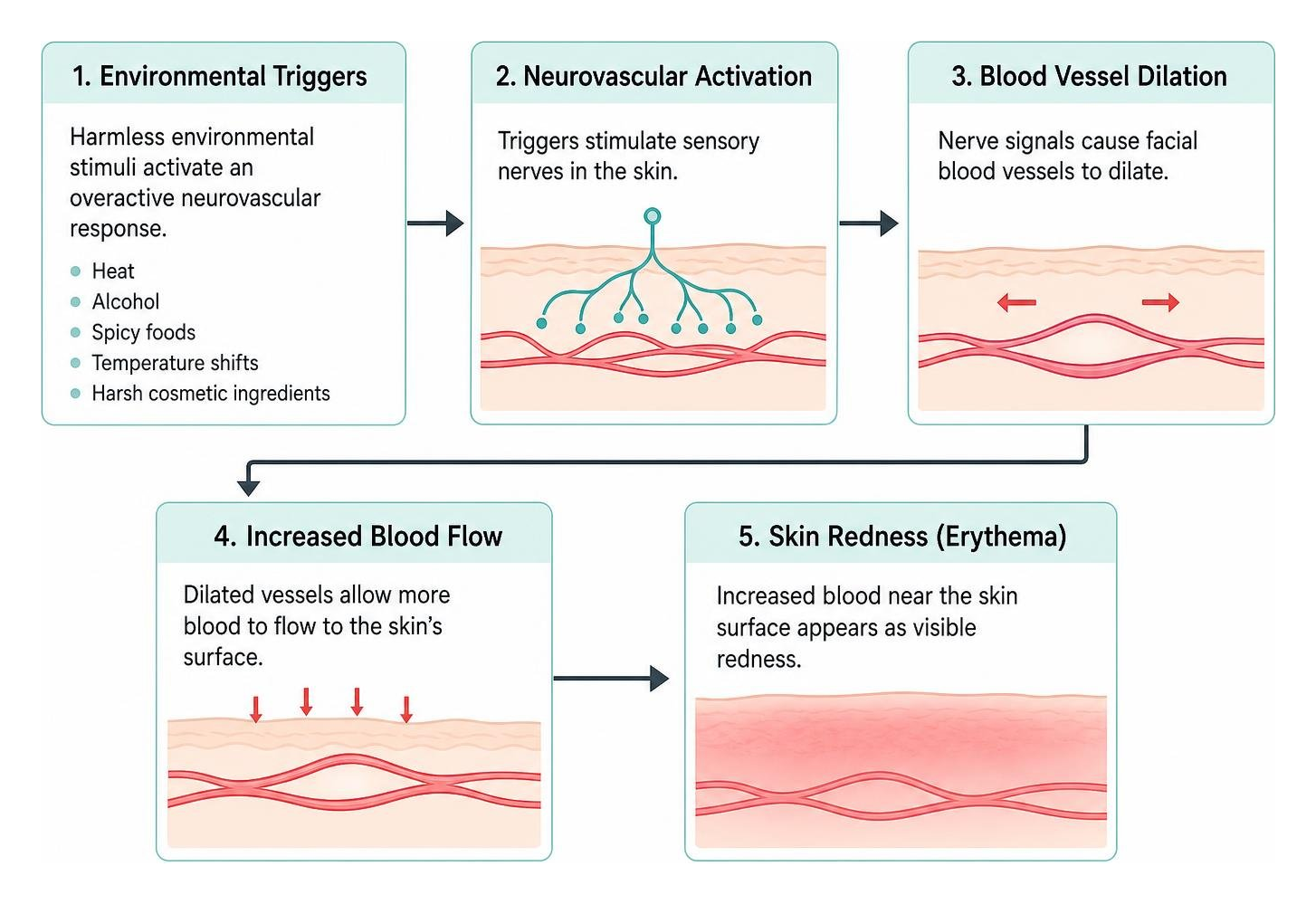
Sudden temperature shifts, harsh cosmetic ingredients, and allergic contact can also compromise the moisture barrier, leaving nerve endings exposed and reactive. When assessing chronic flushing, it helps to understand why persistent flushing happens so you can differentiate everyday sensitivity from underlying dermatological disorders.
| Condition | Primary Symptoms | Common Locations | Distinguishing Feature |
|---|---|---|---|
| Rosacea | Flushing, persistent redness, telangiectasia, papules/pustules | Cheeks, nose, chin, forehead | Central face focus; triggered by heat, alcohol, spice |
| Contact Dermatitis | Intense itching, stinging, localized redness, scaling | Area of contact | Clear reaction after applying specific irritants or allergens |
| Eczema (Atopic) | Dry, itchy, scaly patches, compromised barrier | Cheeks, perioral area, neck, flexural folds | Marked dryness and severe itch without acne-like bumps |
| Lupus (Malar Rash) | Butterfly-shaped red rash, photosensitivity | Spans bridge of nose and cheeks | Strictly spares the nasolabial folds; systemic markers |
Distinguishing Rosacea from Other Skin Conditions
Because facial erythema presents similarly across several disorders, obtaining an accurate differential diagnosis is critical. Rosacea typically begins between the ages of 30 and 60, alternating between active flare-ups and periods of remission. While it occurs most frequently in fair-skinned women who blush easily, men often experience more severe architectural skin changes.
Unlike acne vulgaris, rosacea does not feature clogged pores (comedones/blackheads). Instead, it presents as inflammatory papules, pustules, or direct vascular enlargement across the central face. If redness crosses over the cheeks and nose while sparing the creases around your mouth, an autoimmune issue must be ruled out. Reviewing a detailed differential guide to rosacea, acne, eczema, and lupus provides a clearer picture of symptom distribution. For clinical verification, following established diagnostic guidance from the American Academy of Dermatology ensures conditions requiring medical intervention are handled appropriately.
Primary Environmental and Lifestyle Triggers
Data compiled by the National Rosacea Society highlights that everyday lifestyle factors heavily influence vascular reactivity. The leading triggers include:
- Direct sun exposure and ambient UV radiation
- Hot baths, saunas, and intense indoor heating
- Rapid temperature changes and cold winds
- Emotional stress and anxiety
- Strenuous physical exertion
- Alcoholic beverages (especially red wine)
- Spicy foods and heated soups or drinks
- Harsh cosmetic ingredients like fragrances, alcohol, menthol, and physical scrubs
Keeping a daily flare-up journal allows you to pinpoint individual patterns without unnecessary dietary restrictions. When tracking your skin’s behavior, note what you ate, the weather conditions, and the skincare products used prior to a flush.
Over-the-Counter and At-Home Face Redness Treatment Options
Managing reactive skin begins with restoring the stratum corneum—the outermost layer of your skin barrier. When this lipid shield is depleted, water escapes rapidly, and irritants penetrate deeply, prompting immune cells to release inflammatory chemicals that cause redness.
Switch to non-foaming, fragrance-free cleansers and wash with lukewarm water, as hot water provokes immediate capillary dilation. Immediately follow with a barrier-repair moisturizer packed with physiological lipids:
- Ceramides: Reinforce the intercellular matrix to lock in essential moisture.
- Hyaluronic Acid & Glycerin: Attract water to deeper epidermal layers to soothe tightness.
- Niacinamide (Vitamin B3): Strengthens barrier protein synthesis while calming visible inflammation.
- Centella Asiatica (Cica) & Allantoin: Botanical extracts proven to soothe micro-irritation.
For immediate daytime cosmetic relief, green-tinted mineral primers and color-correcting creams neutralize red tones on the color spectrum without clogging sensitive pores.
Calming Active Ingredients and Topical Formulas
Incorporating gentle actives can gradually quiet reactive vessels. Over-the-counter azelaic acid (10%) gently exfoliates within pores while decreasing cutaneous redness and swelling. Natural anti-inflammatories like licochalcone A (derived from licorice root extract) offer antioxidant protection and calm neurosensory hyperreactivity.
When your skin feels easily provoked, avoid harsh chemical peels, astringents, and physical face scrubs. Instead, consider specialized facial rejuvenation for sensitive skin to support hydration without triggering inflammatory responses.
Daily Sun Protection and Flare Prevention
Sun protection is a non-negotiable step in calming facial redness. UV rays prompt the release of vascular endothelial growth factor (VEGF), fueling new capillary growth and worsening baseline redness.
Always select broad-spectrum mineral sunscreens formulated with zinc oxide and titanium dioxide (SPF 30 or higher). Unlike chemical filters that convert UV rays into heat energy within the skin, physical minerals sit on the surface and reflect rays away, preventing heat-induced flushing. For sudden, intense flushing episodes, applying a cool (not ice-cold) cloth compress delivers immediate vascular constriction. For evidence-based insights on preventative self-care, review the comprehensive clinical review on rosacea therapies by Harvard Health.
Clinical Care: Prescription Medications and Targeted Face Redness Treatment

When lifestyle measures and gentle skincare are not enough to control persistent redness or breakouts, medical intervention becomes necessary. Dermatologists and medical aesthetic specialists tailor prescription plans based on whether symptoms are vascular (flushing, visible vessels) or inflammatory (papules, pustules). Consulting evidence-based therapeutic guidelines by Mayo Clinic helps frame expectations around prescription timelines.
| Treatment Category | Active Ingredient / Therapy | Primary Target | Expected Timeline |
|---|---|---|---|
| Topical Vasoconstrictor | Brimonidine gel, Oxymetazoline cream | Persistent facial erythema | Visible within 1–3 hours; lasts 8–12 hours |
| Topical Anti-Inflammatory | Ivermectin 1%, Metronidazole 0.75-1% | Demodex mites, papules, pustules | 4 to 12 weeks for substantial clearing |
| Topical Dicarboxylic Acid | Azelaic acid 15% gel/foam | Bumps, swelling, post-inflammatory marks | 4 to 8 weeks |
| Encapsulated Retinoid/BPO | Microencapsulated benzoyl peroxide | Inflammatory acne-like rosacea bumps | 2 to 6 weeks with low irritation risk |
| Oral Anti-Inflammatory | Sub-antimicrobial doxycycline (40 mg) | Chronic papulopustular flare-ups, ocular symptoms | 4 to 12 weeks |
| Vascular Laser / BBL | ClearScan 1064 nm, BroadBand Light | Broken capillaries, diffuse erythema | 2 to 4 sessions, spaced 4 weeks apart |
Topical Prescriptions for Erythema and Papules
For persistent diffuse redness, FDA-approved topical vasoconstrictors provide rapid, temporary relief. Brimonidine gel and oxymetazoline cream work by stimulating alpha-adrenergic receptors on superficial blood vessels, causing them to constrict for 8 to 12 hours. These are best used judiciously to avoid rebound flushing upon wear-off.
For inflammatory bumps, modern prescription treatments have advanced considerably. A large scientific review published in JAMA Dermatology (examining 32 trials across 11,399 adults) confirmed that ivermectin 1% cream and microencapsulated benzoyl peroxide cream rank among the most effective topical choices for clearing rosacea-related bumps. Ivermectin targets underlying Demodex populations and calms tissue inflammation, while microencapsulated formulations slowly release benzoyl peroxide to neutralize bacteria without stripping sensitive skin barriers. Metronidazole cream and prescription-strength 15% azelaic acid gel remain reliable cornerstones for ongoing maintenance.
Oral Medications, Ocular Rosacea, and Rhinophyma
When topical agents prove insufficient, systemic therapy can calm widespread inflammation. Low-dose oral doxycycline (40 mg modified-release) delivers anti-inflammatory benefits without exerting antimicrobial pressure, preventing bacterial resistance during long-term use.
About 10% of individuals with rosacea develop ocular rosacea, presenting with gritty, bloodshot, or dry eyes, blepharitis, and light sensitivity. Ocular rosacea requires dedicated eyelid hygiene routines, warm compresses, artificial tears, oral omega-3 fatty acids, and occasionally prescription cyclosporine ophthalmic drops.
In advanced cases—predominantly affecting men—untreated inflammation can lead to rhinophyma, characterized by thickened, bulbous skin on the nose. Early stages respond well to oral isotretinoin, while advanced tissue proliferation is corrected through surgical re-contouring, electrosurgery, or ablative laser therapy.
Professional Procedures and Advanced Laser Face Redness Treatment
While topical and oral medications reduce active inflammation, they cannot eliminate structural telangiectasias or permanent vascular networks. For these fixed vessels, energy-based technologies provide clinical clearance. At our Montclair, NJ clinic, our board-certified surgical team oversees advanced in-office skin treatments to ensure safe, natural-looking correction across all skin types.

Energy-based vascular devices rely on the principle of selective photothermolysis. Light energy is precisely tuned to be absorbed by oxyhemoglobin inside target blood vessels. The absorbed light converts to heat, safely coagulating the vessel walls without damaging the overlying skin. The body’s lymphatic system naturally absorbs and clears the collapsed vessel over the following weeks. Explore our comprehensive customized laser treatments to see how modern wavelengths address vascular concerns.
Vascular Lasers and ClearScan 1064 nm Technology
The ClearScan laser uses an advanced 1064 nm Nd:YAG wavelength designed specifically for vascular targeting. Because the 1064 nm wavelength penetrates deeper into the dermis than traditional light devices, it effectively treats:
- Prominent, distinct spider veins around the nose and cheeks
- Deeper, bluish-red vascular networks
- Resistant facial telangiectasias
The laser’s integrated contact cooling protects the epidermis, ensuring treatments remain comfortable while delivering high clinical precision with minimal recovery downtime.
BroadBand Light (BBL) and Restorative Light Therapies
For diffuse background redness, frequent flushing, and mottled sun damage, BroadBand Light (BBL) therapy provides comprehensive clearance. BBL delivers broad-spectrum light pulses across multiple wavelengths, addressing broad erythema while stimulating dermal collagen remodeling to thicken and support fragile skin.
For individuals with highly reactive, sensitive skin who require non-thermal calming, light-emitting diode phototherapy offers a zero-downtime alternative. Discover the cellular light therapy benefits for skin conditions, or explore how soothing Celluma LED light therapy utilizes blue, red, and near-infrared wavelengths to downregulate cutaneous inflammation, accelerate cellular repair, and calm flushing.
Frequently Asked Questions About Facial Redness
How can I tell if my facial redness is caused by rosacea or just sensitive skin?
Sensitive skin generally reacts temporarily to specific topical triggers (such as strong acids or fragrances) and improves once the irritant is removed. Rosacea is a progressive, chronic condition characterized by central facial erythema, visible broken capillaries, burning sensations, and distinct physical triggers like heat, alcohol, or emotional stress. A clinical evaluation can accurately identify your skin’s condition.
What is the fastest way to calm acute facial flushing at home?
To calm sudden facial flushing, move to a cool environment and apply a clean cloth soaked in cool (not icy) water to the face for 10 to 15 minutes. Mist with pure thermal spring water and apply a ceramide-rich, fragrance-free soothing balm. Avoid hot showers, spicy foods, alcohol, and active exfoliants until the skin settles.
Are vascular laser and light treatments permanent for redness?
Vascular lasers and BBL permanently collapse and remove the specific blood vessels treated during a session. However, because underlying conditions like rosacea and photoaging are chronic, your body can develop new dilated capillaries over time. Maintaining results requires diligent daily broad-spectrum sun protection, trigger management, and occasional maintenance touch-ups every 12 to 18 months.
Clear Paths to Lasting Skin Calm
Achieving a calm, even complexion requires a coordinated approach that targets the root causes of facial inflammation. Effective face redness treatment blends daily barrier-repair skincare and diligent mineral UV protection with clinical therapies like ClearScan vascular lasers, BroadBand Light, and targeted prescriptions.
If persistent flushing or visible vessels affect your confidence, our medical team provides personalized care tailored to your specific skin type. Serving patients across Northern New Jersey—including Montclair, Glen Ridge, Bloomfield, Cedar Grove, Verona, and Clifton—we combine clinical expertise with physician-led oversight to restore clarity and comfort to your skin. We invite you to schedule an evaluation to understand why your face is always red and build your customized treatment plan today.